When most people think about astrology, they picture quick horoscopes or one-line descriptions of their sun sign. You might check your daily prediction in the newspaper or scroll through a meme that says “Aries loves adventure” or “Taurus loves food.” But here’s the deal, astrology runs much deeper than that. Behind every love match and personality description lies an entire system of charts, planets, elements, and houses. Without this depth, you only see a small part of the picture.
That’s why educational deep dives matter. They take you past surface-level results and explain the reasons behind compatibility. When you read them, you understand not only what the match looks like but also why it works or struggles. These guides bridge the gap between casual curiosity and serious learning, making astrology accessible while still grounded in depth.
“Astrology deep dives are not about prediction, they are about explanation.”
Why Deeper Astrology Explanations Matter
Beyond Sun Sign Basics
Many beginners first understand relationship patterns by reading zodiac compatibility explained, where elemental behaviour and personality traits are described through real interactions.
Sun signs show your core identity, but they don’t explain emotions, attraction, or how you build trust. Two Libras may share similar sun qualities but live very different love stories because one has a Scorpio moon and another has a Gemini moon.
That difference alone can change how each reacts to stress, romance, or daily routines. A deep dive explains these extra layers and shows you how to read them. Without looking beyond the sun, relationships can appear simple on paper but feel complex in real life.
Quick points:
- Sun = core identity
- Moon = emotions and comfort
- Rising = first impression
- Venus = love style
- Mars = drive and attraction
Example scenario: Imagine two Aries dating each other. Both have a direct, expressive style, but a Pisces Moon and a Capricorn Moon may lead them to seek emotional safety in different ways. That difference can shape how quickly they trust or how they fight.
Helping Students, Readers, and Casual Seekers
Deep dives serve all types of readers:
- Students use them for projects, essays, or research in psychology, culture, or media.
- Casual seekers gain clarity on why astrology goes beyond simple lists and memes.
- Learners build confidence when they connect theory with practice and see how calculators match explanations.
When your site explains things clearly, people trust it as a learning space, not just an entertainment stop. Over time, it becomes the type of source people bookmark and recommend to friends.
Key Areas Covered in Deep Dives
Birth Charts and Relationship Influence
Astrology students eventually study birth chart compatibility because planetary placements reveal emotional reactions and commitment patterns beyond simple sun sign comparisons.
A birth chart works like a snapshot of the sky at the time you were born. It shows the sun, moon, and planets placed in signs and houses. Compatibility gets clearer when you see how two charts connect.
For instance, one person’s Venus in Leo and another person’s Mars in Leo may be read together when discussing attraction and how interest is expressed. A deeper look into birth charts explains why surface matches may feel misleading. It also shows synastry, where two charts are compared to find harmony and tension points.
Table: Planets and Their Role in Compatibility
| Planet | Role in Compatibility |
|---|---|
| Sun | Identity, core self |
| Moon | Emotions, inner needs |
| Venus | Love language, values |
| Mars | Desire, physical spark |
| Saturn | Stability, long-term |
Elements in Astrology (Fire, Earth, Air, Water)
Another helpful approach is studying elements in astrology compatibility, since fire, earth, air, and water signs behave very differently in relationships.
Every sign belongs to one of four elements. Fire signs bring passion, Earth signs bring stability, Air signs bring ideas, and Water signs bring emotion. When elements mix, relationships form unique patterns. Fire and air create excitement, while water and earth create nurturing bonds. On the other hand, clashes occur when fire overwhelms water or air feels too detached from earth.
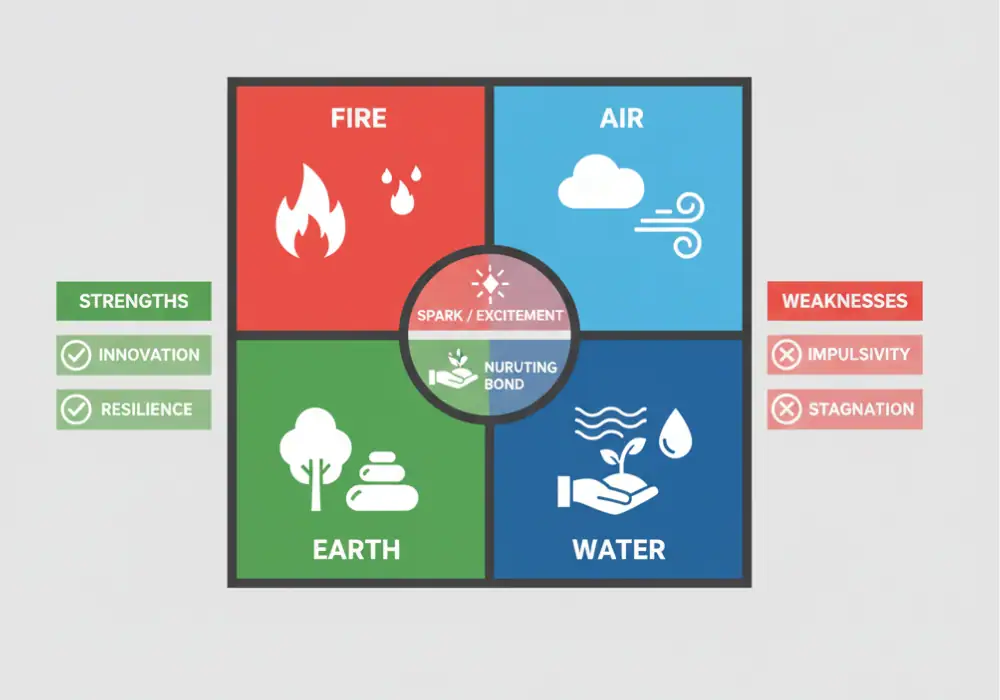
Table: Elements and Relationship Patterns
| Element | Strengths | Weaknesses |
|---|---|---|
| Fire | Passion, excitement | Impulsiveness |
| Earth | Stability, loyalty | Stubbornness |
| Air | Communication, ideas | Restlessness |
| Water | Empathy, care | Over-sensitivity |
Case example: A Sagittarius (fire) and Gemini (air) may thrive on travel and discussion, while a Cancer (water) and Virgo (earth) may find comfort in building a home together.
Astrology Houses and Bonds
Houses represent areas of life. The 5th house covers romance and fun. The 7th house rules partnerships and marriage. The 8th house rules intimacy and transformation. When planets fall into these houses in a compatibility chart, they reveal how a relationship may evolve. A sun landing in someone’s 7th house may bring a strong sense of partnership, while Venus in the 5th house may bring playful romance.
Table: Houses and Love Meanings
| House | Theme | Impact on Relationships |
|---|---|---|
| 5th | Romance, play, joy | Early attraction, dating vibes |
| 7th | Partnerships, marriage | Serious bonds, commitments |
| 8th | Intimacy, shared resources | Trust, deep connection |
| 11th | Friendship, community | Shared goals, bonding |
Quote:
“Houses show where love happens, planets show how it happens.”
Venus and Mars in Love
Venus is about how you love and what you value. Mars is about how you act and show passion. Together, they describe chemistry. A Venus in Cancer person may want tenderness, while a Mars in Aries partner may prefer bold pursuit. Compatibility calculators that include Venus and Mars generally give results that feel closer to reality than sun signs alone.

Bullets:
- Venus = how affection is shown
- Mars = how desire is expressed
- Venus + Mars harmony = smooth attraction
- Venus + Mars clash = mismatched desires
Scenario: A couple may feel emotionally secure but mismatched physically if their Venus and Mars placements do not complement each other. This is why one couple feels romantic stability but low spark, while another feels the opposite.
Sun, Moon, and Rising Differences
A clearer explanation of personality layers appears in sun moon and rising sign compatibility, where identity, emotional instinct, and outward behaviour are studied together.
Your sun shows your identity, the moon shows emotions, and the rising sign shows first impressions. Together, they form a trio that shapes how people see you and how you feel in love. Three people with the same sun sign can act completely differently in romance because their moon and rising signs shift the tone.
Example: A Virgo sun with Aries rising feels bold and outspoken, while a Virgo sun with Pisces rising feels gentle and dreamy. Both are Virgos, but their love stories unfold very differently.
Bullets:
- Sun = identity and willpower
- Moon = emotional safety
- Rising = an approach to the world
- A trio together = a complete picture of personality
How These Dives Build Trust
Educational guides position your site as a knowledge base. Readers see that you are not just repeating daily horoscopes but explaining systems step by step. Teachers and students may even quote your site in their work. Over time, this builds credibility. Casual readers may come for fun but stay because they discover structured learning.
Why trust grows:
- Detailed explanations with context
- Real examples tied to daily life
- Clear visuals like tables and lists
- Practical applications with calculators
- Evergreen content that feels reliable
Linking Dives With Tools and Engagement Content
You can explore these concepts practically through our compatibility calculator tool, where birth details help compare two charts in a structured way.
The strength of deep dives grows when you connect them to practical tools:
- A Venus and Mars post should link to a calculator where readers can test their Venus-Mars match.
- A guide on elements should link to quizzes or ranking posts.
- A birth chart guide should connect with tutorials on how to read charts.
When readers test themselves right after learning, the information sticks longer. It also increases interaction because people like sharing their results with friends.
FAQs
Why is deep astrology content important for beginners?
It helps beginners see why astrology is more than stereotypes. It introduces them to planets, houses, and elements in simple steps.
Do I need to know all planets to understand compatibility?
Not at first. Start with the sun, the moon, Venus, and Mars. Add Saturn and houses for deeper insight. A gradual approach prevents overwhelm.
How do houses and planets affect quick calculator results?
Calculators give surface matches, but houses and planets explain why the score feels right or wrong in daily life. They add the missing context.
Can casual readers enjoy deep dives, or are they only for experts?
Deep dives are for all levels. Clear examples help beginners, while structured overviews benefit advanced readers.
Can deep dives replace professional readings?
They cannot replace personal readings entirely, but they give strong foundations. Readers learn enough to ask better questions when visiting astrologers.
What’s the biggest benefit of deep dives?
They build confidence. Readers know they are not relying only on stereotypes but on layered explanations.
Conclusion
Educational deep dives make astrology practical and trustworthy. They explain the “why” behind compatibility, not just the “what.” Readers walk away with knowledge and confidence to apply it. So finally, your site becomes more than a calculator hub. It becomes a trusted space where students, casual seekers, and astrology lovers can learn, test, and return for more. This combination of depth and interaction is what builds lasting trust. At the end of the day, deep dives serve as both learning resources and interactive tools that keep readers engaged.
Practical Checklist
- Add detailed posts on birth charts, elements, houses, Venus and Mars, and sun-moon-rising.
- Link each post to calculators or quizzes for practical use.
- Use real examples to make concepts clear.
- Write for beginners while keeping depth for advanced readers.
- Keep deep dives as evergreen content for long-term value.
- Add visuals like tables, bullet lists, and quotes.
- Refresh posts regularly with new insights.
- Encourage readers to apply knowledge using calculators or quizzes.
- Add case studies or scenarios to show concepts in action.
- Build interlinks with engagement posts like myths vs facts or compatibility rankings.