Some astrology traditions use the word ‘karmic’ for relationships that bring strong responsibility, pressure or repeated lessons to the foreground. That language is a tradition, not proof of past lives, destiny or karmic debt. In everyday relationship behaviour, Saturn is more useful when it is translated into limits, patience, obligation, consistency and the work required to repair a strain.
The article keeps its existing title and slug because the search phrase matters, but the explanation stays grounded. Saturn does not prove that two people are destined to remain together, and it does not punish a couple that leaves.

This illustration uses traditional symbolic astrology wording. The surrounding explanation treats the image as an illustration and discusses responsibility, pressure, boundaries and repeated behaviour rather than taking supernatural claims as fact.
The Weight You Cannot Ignore
Saturn patterns may be discussed when a relationship brings an obligation into focus: caring for family, managing money, keeping a promise, setting a limit or returning to a difficult conversation. The weight becomes constructive only when both people can say what is required and whether the requirement is fair.
When Attraction Feels Like Obligation
A strong attachment can make a person stay involved even when the relationship is exhausting. The practical question is not whether the bond is ‘meant’ to last. Ask whether the two people can share responsibility, respect consent and change the pattern that keeps causing harm.

Pressure That Reveals a Pattern
Pressure often exposes how each person handles limits. One may take charge of every task and later feel resentful. The other may avoid decisions and then feel controlled. A useful reading names the trigger, each first response and the repair: divide the task, set a date and check whether the agreement was kept.
Endurance vs Avoidance
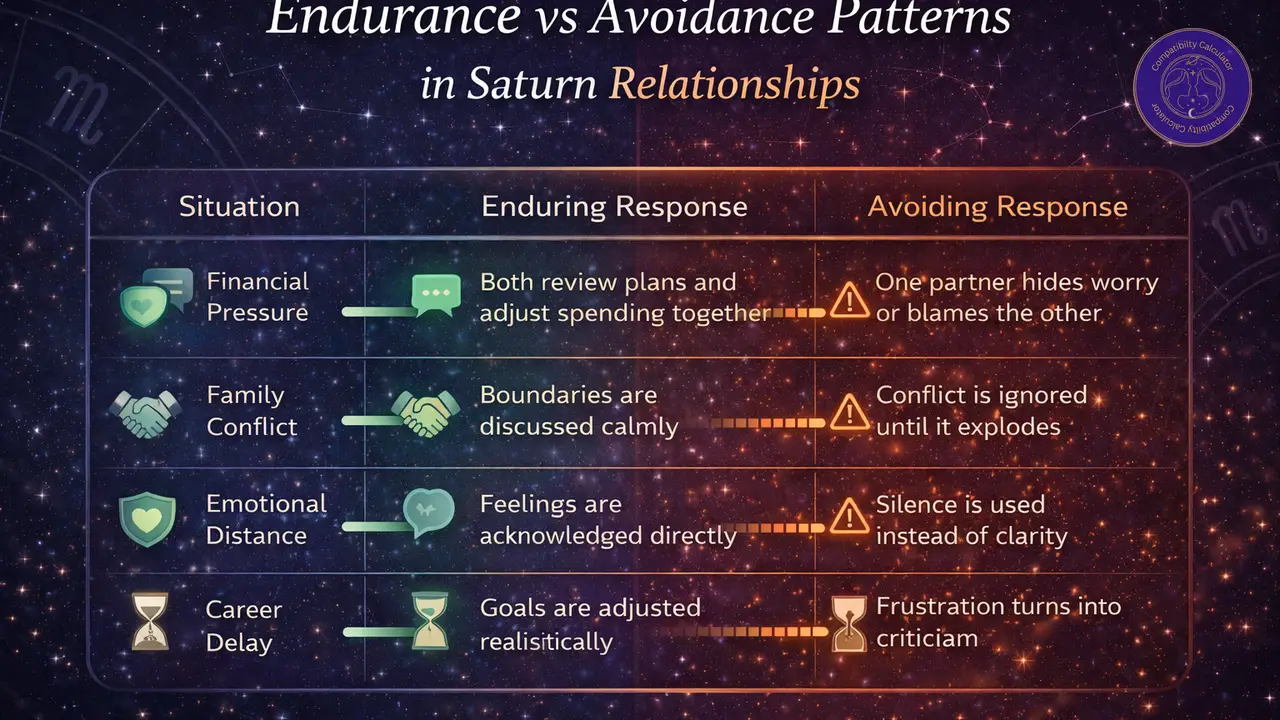
| Pattern | What it may look like | Grounded question |
|---|---|---|
| Endurance | A difficult duty is handled without using it as a weapon. | Is the effort shared and acknowledged? |
| Avoidance | A repeated obligation is delayed until someone else carries it. | What is the next action and who owns it? |
| Pressure | Rules or expectations become a source of fear or control. | Can the boundary be discussed without punishment? |
| Maturity | Both people accept limits and revise an unfair arrangement. | What changed in daily behaviour, not only in the promise? |
When a Relationship Feels Like a Lesson
The phrase ‘karmic relationship’ can describe the feeling that the same issue keeps returning. A grounded interpretation asks what repeats: a broken promise, a boundary that is ignored, a fear of dependence or a duty that is never divided. The lesson is not a supernatural sentence. It is the information contained in the repeated pattern.
Toxic Is Not the Same as Transformative
Difficulty does not make a relationship valuable, and suffering is not proof of depth. A relationship is not made healthy by calling control a lesson or fear a commitment. If there is coercion, threats, isolation or repeated harm, the practical response is safety and support, not more astrology language.
When a Pattern Begins to Change
Change becomes visible when the old trigger produces a different first response. The person who used to avoid the conversation gives a time to return. The person who used to control the outcome asks what the other person can carry. A promise matters only when the next ordinary week shows a different action.
The planetary parent guide places Saturn beside communication, emotional safety, affection and growth. Use Full Chart compatibility for a wider Western astrology reading, while keeping traditional Saturn language conditional.
FAQs
Are karmic relationships meant to last forever?
No. ‘Karmic’ is a traditional label, not proof of permanence. A relationship still needs consent, safety, shared responsibility and workable behaviour.
Why can Saturn relationships feel restrictive?
The relationship may bring limits, duties, pressure or expectations into focus. The practical question is whether those limits are fair and openly discussed.
Can Saturn patterns soften over time?
They may become easier when responsibilities are shared, boundaries are respected and repeated conflict leads to a different action.
How do you know when a lesson is complete?
Look for sustained behaviour change: the trigger no longer produces the same avoidance, control or broken agreement. Astrology cannot certify completion.