Foundation: Identity, Stability, and Emotional Safety
A marriage begins with structure rather than attraction, because daily life requires stability, responsibility, emotional security, and practical cooperation beyond chemistry. Two people may feel a strong attraction, yet marriage depends on identity alignment, emotional needs, and responsibility patterns working together in daily life.
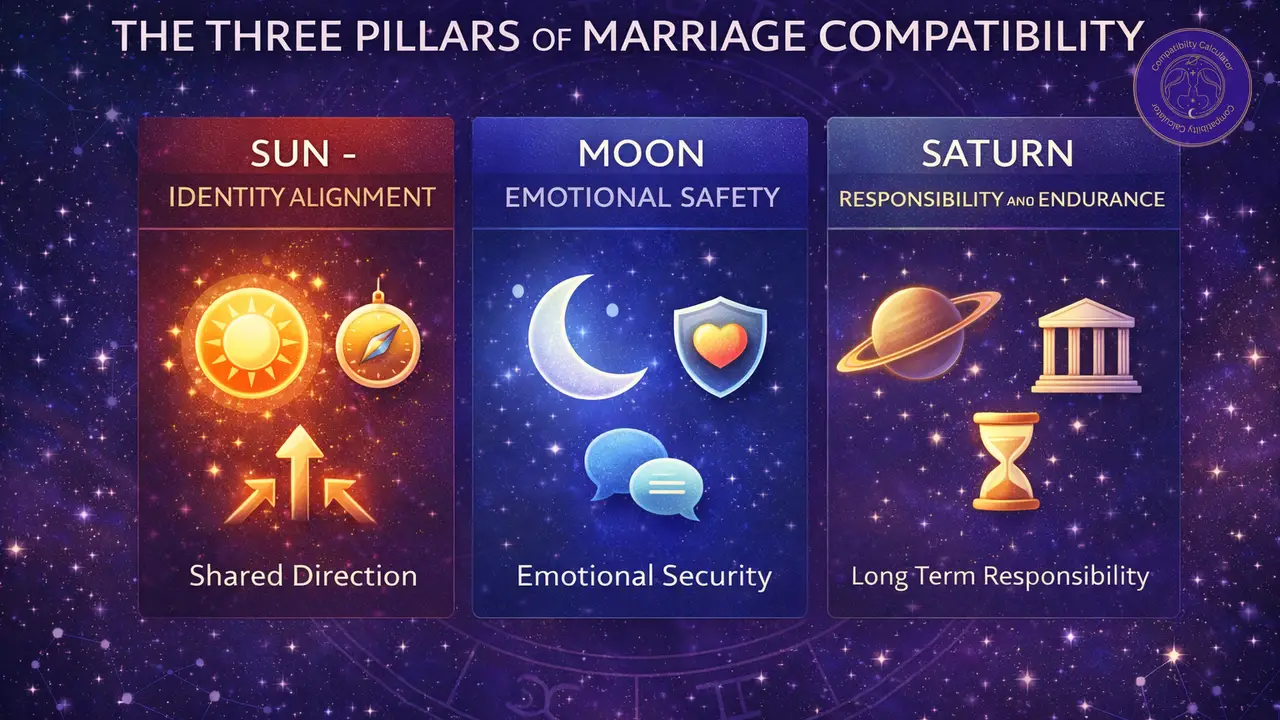
In a committed partnership, personality direction matters as much as emotional comfort, since long-standing commitment requires shared vision and dependable behavior. The Sun, Moon, and Saturn create the base of marital structure because identity, instinctive reaction, and responsibility shape experience inside the home.

Marriage readings should not ignore attraction, but they need a wider frame than early chemistry. The page on love compatibility in astrology explains the romantic side, while relationship compatibility in astrology gives the broader view of trust, communication, and long-term fit.
The Difference Between Attraction and Marriage Compatibility
Attraction grows through excitement and physical chemistry, yet marriage depends on consistency and reliability in behavior. During the early stages, excitement may bring two people together, but structure determines whether the partnership remains stable through stress and routine.
In periods of ease, harmony may appear natural, while under pressure, financial stress, family involvement, or emotional difficulty reveals whether compatibility remains strong. Emotional security carries more weight in marriage than dramatic intensity.
- Attraction builds through chemistry.
- Marriage depends on stability.
- Excitement fades without structure.
- Emotional safety supports commitment.
- Responsibility strengthens partnership.
Sun Compatibility – Identity and Direction
The Sun represents identity and life direction, so Sun compatibility shows whether two people move toward similar priorities. In relationships where identity patterns align, cooperation becomes easier because both partners respect each other’s pace and ambition.
In situations where Sun patterns clash, ego friction may appear because personal direction differs. Disagreement may arise around priorities, career focus, lifestyle rhythm, or independence.
When Sun Signs Align
In marriages where Sun signs align, a similar life focus appears, and daily coordination feels natural because both partners value similar priorities. Respect for individuality remains stable when identity direction does not compete.
- Similar lifestyle rhythm.
- Respect for independence.
- Agreement on priorities.
- Comparable pace of progress.
When Sun Signs Clash
In marriages where Sun signs differ strongly, personal direction may conflict, and ego tension may grow when one partner dominates or resists adjustment. Timing differences may create frustration when goals move at different speeds.
- Competing focus.
- Power struggle.
- Uneven ambition.
- Conflict over control.
Sun Alignment Table
| Area | Harmonious Suns | Clashing Suns |
|---|---|---|
| Life priorities | Similar direction | Competing focus |
| Ego expression | Mutual respect | Power tension |
| Growth pace | Coordinated | Uneven timing |
| Daily rhythm | Compatible | Friction in routine |
Moon Compatibility – Emotional Safety and Instinct
The Moon represents emotional needs and instinctive reaction, so Moon compatibility shows whether comfort and reassurance feel natural in marriage. Emotional safety determines how quickly hurt heals and how openly vulnerability appears.

In marriages where Moon patterns align, partners understand each other’s reaction speed and comfort style. In marriages where Moon patterns differ, one partner may withdraw while the other seeks closeness, and misunderstanding can grow between them.
Emotional Comfort Patterns
Under stress, illness, disappointment, or private conversation, emotional comfort becomes visible. Reassurance style matters because one partner may require verbal support while the other prefers quiet presence.
- Similar reaction to stress.
- Matching reassurance style.
- Comfortable vulnerability.
- Predictable emotional rhythm.
Emotional Mismatch Patterns
A mismatch appears when reaction speed differs, since one partner may react immediately while the other reflects quietly before speaking. In cases where tone sensitivity differs, hurt can follow when one partner speaks directly, and the other reacts emotionally.
- One partner seeks space.
- One partner seeks closeness.
- Tone differences create hurt.
- Withdrawal replaces discussion.
Moon Interaction Table
| Area | Compatible Moons | Mismatched Moons |
|---|---|---|
| Stress reaction | Similar | Different |
| Comfort style | Mutual understanding | Misinterpretation |
| Expression speed | Aligned | Uneven |
| Emotional repair | Quick | Delayed |
Saturn Compatibility – Responsibility and Endurance
Saturn represents responsibility, maturity, and endurance, so Saturn compatibility shows whether both partners carry duty evenly. Marriage stability depends on shared accountability and financial discipline during hardship.
In partnerships with strong Saturn alignment, both partners accept responsibility and face difficulty directly. In partnerships with weak Saturn alignment, avoidance, inconsistency, or uneven burden may create strain.
- Responsibility is carried equally.
- Financial discipline maintained.
- Commitment remains steady.
- Crisis handled with maturity.
Structural Stability Table
| Factor | Strong Saturn Alignment | Weak Saturn Alignment |
|---|---|---|
| Responsibility | Shared evenly | Uneven burden |
| Financial management | Coordinated | Disagreement |
| Commitment | Stable | Inconsistent |
| Crisis response | Direct handling | Avoidant |
Daily Life, Communication, and Conflict
Marriage moves from theory into routine once daily responsibilities begin to shape interaction. Although attraction may still exist, communication style, role expectations, and response during disagreement determine whether harmony continues on ordinary days.
In everyday life, coordination between two adults becomes necessary because thinking style and reaction speed may differ. One partner may prefer immediate discussion when a problem appears, while the other may prefer reflection before speaking, and this difference alone can create tension if not understood clearly.
Mercury Compatibility – Communication Style
Mercury represents communication, and in marriage, it shows how partners talk during stress, explain concerns, and respond to criticism. In relationships where Mercury styles align, conversation flows more naturally because tone and pacing feel familiar.
In relationships where Mercury styles differ, misunderstanding may increase because one partner may speak directly while the other interprets tone emotionally. Over time, repeated misinterpretation can reduce comfort in discussion if adjustment does not occur.
- Direct speech may clash with a sensitive tone.
- A fast explanation may frustrate slower processing.
- Silence may be misread as avoidance.
- Debate may be misread as an attack.
Communication Pattern Table
| Pattern | Aligned Mercury | Misaligned Mercury |
|---|---|---|
| Tone | Similar | Frequently misunderstood |
| Reaction speed | Comparable | Uneven |
| Conflict style | Discussion based | Argument based |
| Resolution pace | Cooperative | Delayed |
Division of Roles and Expectations
Marriage requires clarity about responsibility inside the home and outside it. Household tasks, financial management, career focus, and family involvement must feel fair, or resentment may grow quietly over time.
In some partnerships, equal division of tasks feels necessary, while in others, role based structure follows preference or tradition. Conflict may appear when expectation remains unspoken, and effort feels unequal.
- Household duties must feel fair.
- Financial contribution must feel respected.
- Career priorities must be discussed openly.
- Family boundaries must remain clear.
How Conflict Builds in Marriage
In most marriages, conflict rarely appears suddenly without warning, because small patterns usually repeat before larger disagreement develops. Tone difference, unmet expectation, or repeated criticism may slowly increase irritation.
Across different element types, reaction style during conflict varies. Fire signs react quickly and speak openly, Earth signs withdraw and evaluate before responding, Air signs analyze and explain their position, and Water signs internalize hurt before expressing it.
When reaction style remains misunderstood, frustration accumulates. Repair requires awareness of how each partner reacts rather than forcing an identical response.
Conflict Pattern Table
| Element Type | Trigger | Reaction | Repair Method |
|---|---|---|---|
| Fire | Ego challenge | Direct argument | Clear apology |
| Earth | Practical imbalance | Quiet distance | Consistent correction |
| Air | Miscommunication | Extended discussion | Clarification |
| Water | Emotional hurt | Withdrawal | Reassurance |
Loyalty and Commitment Patterns
Trust inside marriage develops through repeated behavior rather than promises. When words and actions remain consistent, security increases and suspicion decreases.
In situations where trust is damaged, stability weakens even if attraction remains strong. Forgiveness requires acknowledgment of error and visible behavior change, because repeated mistake without correction reduces confidence in a partnership.
Growth, Family Life, and Endurance Over Time
Over time, marriage changes as responsibilities expand and personal priorities shift. A couple may begin with strong agreement, yet new pressures, such as parenting, relocation, or career change, test whether adaptation happens smoothly.
As years pass, emotional maturity influences stability more than attraction. Personal growth must be respected, or resentment may develop when one partner feels restricted.
Growth Alignment
A marriage remains stable when both partners support each other’s development instead of competing for control. When growth pace differs, frustration may appear because one partner moves forward while the other prefers continuity.
Over several life stages, change becomes unavoidable. Acceptance of change reduces tension, while resistance increases distance.
- Personal development must be respected.
- Changing priorities must be discussed.
- Emotional maturity must increase with time.
- Adjustment must remain mutual.
Growth Alignment Table
| Area | Aligned Pattern | Misaligned Pattern |
|---|---|---|
| Personal growth | Supportive | Competitive |
| Career evolution | Cooperative | Resentful |
| Lifestyle change | Adaptive | Resistant |
| Emotional maturity | Progressive | Stagnant |
Family and Social Structure
A family environment introduces new expectations that influence marriage stability. Parenting style, extended family boundaries, and social habits may create either cooperation or strain.
When parenting values align, daily coordination feels organized. When parenting approaches differ, repeated disagreement may weaken unity inside the home.
Extended family involvement requires clear limits, because unclear boundaries may create tension between loyalty to spouse and loyalty to relatives.
- Parenting expectations must align.
- Extended family boundaries must remain clear.
- Social lifestyle must feel comfortable for both.
- Household structure must feel fair.
Family Stability Table
| Factor | Harmonious Pattern | Strained Pattern |
|---|---|---|
| Parenting style | Consistent | Conflicting |
| Family boundaries | Clear | Intrusive |
| Social habits | Similar | Mismatched |
| Home routine | Predictable | Disorganized |
Long Lasting Marriage Indicators
A stable marriage shows repeated patterns of respect and accountability. Conflict still appears, yet repair follows with acknowledgment and behavioral correction.
Over the decades, endurance depends on responsibility and emotional awareness. Pride without adjustment increases separation, while humility strengthens partnership.
- Respect remains visible.
- Responsibility remains shared.
- Conflict ends with repair.
- Growth continues on both sides.

A score can be useful when it helps you notice the main pressure points instead of giving a simple yes or no. The compatibility calculator tool gives that starting point, and the page on astrology compatibility calculator accuracy explains how to read the result responsibly.
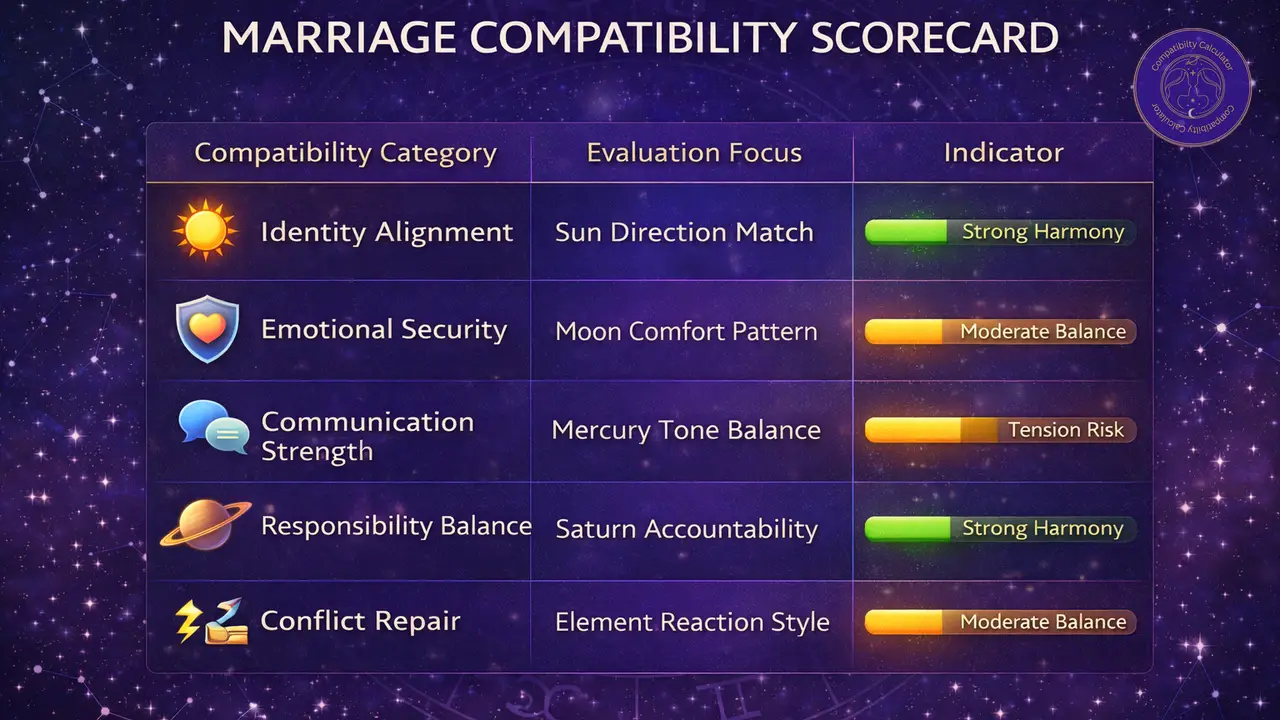
Full Marriage Compatibility Scorecard
| Category | Evaluation Focus |
|---|---|
| Identity Alignment | Sun direction match |
| Emotional Security | Moon comfort pattern |
| Communication Strength | Mercury tone balance |
| Responsibility Balance | Saturn accountability |
| Conflict Repair | Element reaction style |
| Endurance Potential | Maturity and adaptation |
Reflection
A marriage requires ongoing evaluation of identity alignment, emotional comfort, communication style, and responsibility balance. When tension increases, awareness of reaction pattern and willingness to adjust determine whether stability returns.
Personal reflection becomes necessary during major life transitions because ignoring imbalance increases distance. Honest conversation restores clarity when both partners remain accountable.
Frequently Asked Questions
1. Can opposite signs maintain a stable marriage?
Opposite signs can maintain stability when differences are understood instead of criticized. Adjustment becomes necessary when reaction style and emotional needs contrast strongly.
2. Does emotional compatibility matter more than shared direction?
Emotional compatibility supports daily harmony, while shared direction influences long-range planning. Both identity alignment and emotional comfort must operate together for durability.
3. How important is Saturn in marriage?
Saturn influences responsibility and endurance in marriage. When accountability remains equal, stability increases even during hardship.
4. Can a strong attraction compensate for a structural mismatch?
Attraction may create temporary harmony, yet a structural mismatch appears during stress. Without responsibility balance and emotional understanding, tension gradually increases.
Final Marriage Compatibility Checklist
- Identity direction aligned.
- Emotional comfort is secure.
- Communication respectful.
- Responsibility is evenly carried.
- Conflict repaired properly.
- Growth is supported consistently.