A list of astrology compatibility tools is only useful when it tells a reader what to inspect. Calling one site the best would turn a personal comparison into an unsupported ranking, especially when tools use different traditions, inputs and result formats.
What to Look for in an Astrology Compatibility Tool
Start with the question the tool says it answers. A sign-level match, a Western Full Chart comparison and a Vedic Ashtakoota or Guna Milan calculation are not the same product, even when each page uses the word compatibility.
| Comparison point | What to inspect |
|---|---|
| Input requirements | Does the page explain whether it needs date, location, birth time, signs or optional names? |
| Unknown birth time | Does it say what changes when the time is missing instead of presenting an exact chart without that information? |
| Method | Does it name Western, Vedic or numerology methods and keep their scoring systems separate? |
| Result explanation | Does it explain the score and show what each category refers to? |
| Privacy wording | Does it distinguish browser processing, storage, cookies, analytics and third-party requests? |
| Claims and limits | Does it avoid promises about marriage, breakup, fixed outcomes or relationship success? |
Compare Depth Without Calling It Accuracy
A tool that asks for birth time and location may discuss more chart detail than a sign-only match. That difference describes input depth, not proof that the interpretation is scientifically accurate. A short result may fit a reader who wants a starting point; a longer report may fit someone studying aspects, houses or a traditional matching method.
Keep Western, Vedic and Numerology Methods Distinct
Western astrology may use a tropical zodiac and chart positions; Vedic educational pages may discuss a sidereal zodiac, Rashi, Nakshatra, Ashtakoota, Guna Milan or Manglik considerations; numerology may use Life Path, Birthday Number, Expression or Destiny, Soul Urge or Personality Number. A comparison is clearer when a tool says which system it uses rather than presenting all of those labels as one score.

How CompatibilityCalculator.net Fits the Criteria
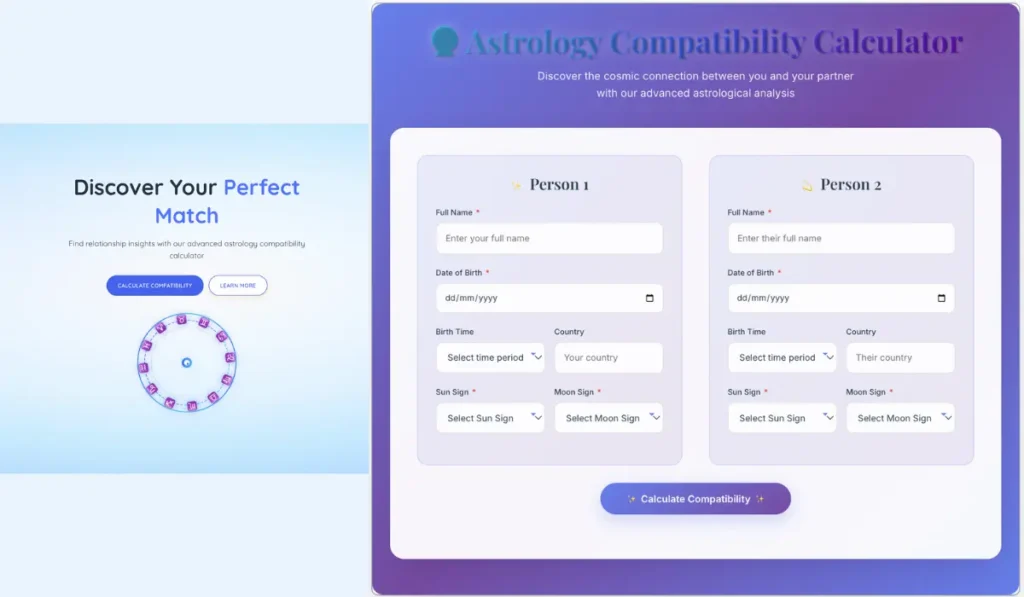
The current CompatibilityCalculator.net calculator documents two different modes: Western Full Chart and Sun Moon & Rising. Full Chart uses birth date, selected birth location and birth time when known; names are optional and do not determine planetary positions. The Methodology page records the product boundary and the privacy article explains why browser processing is not the same question as storage or analytics.
This page does not assign a numerical rating to CompatibilityCalculator.net or to another service. It gives readers criteria they can apply to any current tool after reading that tool’s own pages and privacy terms.
A Short Review Checklist
- The input fields match the method the page says it uses.
- The result explains what the score and categories mean.
- The page says what happens when birth time is unknown.
- The privacy and outcome language stays narrower than a guarantee.
Frequently Asked Questions
Is the tool with the highest score the best?
No. Scores from different methods are not comparable as a universal ranking. Inspect the method, inputs, explanation and limits instead.
Should I compare Western and Vedic scores directly?
No. They use different traditions and calculation frameworks. Read each result within the system that produced it.
Does a longer report mean a more accurate result?
Not by itself. More text may reflect more inputs or categories, but length does not prove scientific accuracy or a future outcome.
What privacy detail should a comparison include?
Look for clear wording about data requested, browser processing, storage, cookies, analytics, third-party services and retention.