How Emotional Needs Show Up Without Being Announced
You can sit beside someone you love and still feel slightly alone, not because they did something wrong, but because they responded differently than you quietly hoped they would. Moon sign compatibility begins in those small private moments when comfort is expected without being clearly requested.

Many emotional needs are never spoken about directly. One partner may expect reassurance during a stressful week, while the other assumes silence means everything is fine. One partner may hope for physical closeness after a difficult day, while the other believes giving space is the most respectful response. Neither person intends to disappoint the other, yet disappointment appears when comfort styles do not match.
Moon energy reflects instinctive reactions and early emotional conditioning. It shows how a person responds when tired or hurt or overwhelmed or uncertain. These responses usually surface automatically, without calculation or strategy, which is why Moon compatibility can feel effortless in some relationships and confusing in others.
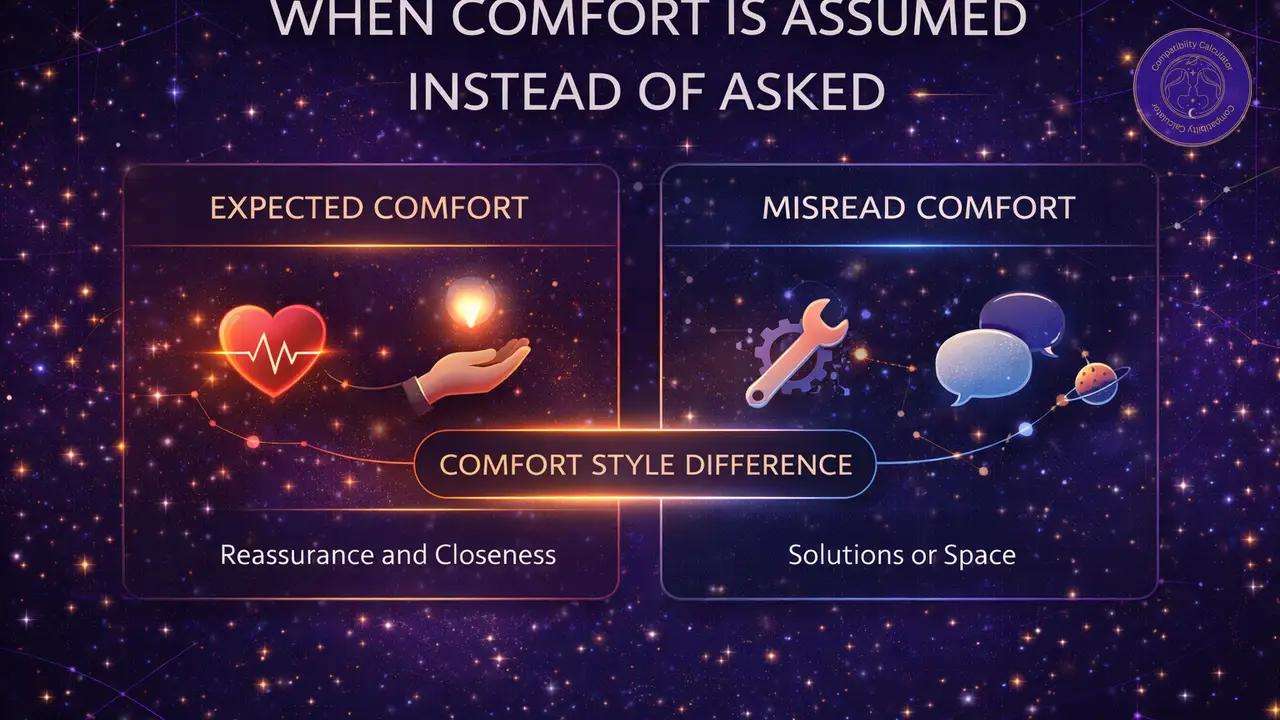
When Comfort Is Assumed Instead of Asked
Unspoken expectations create subtle tension over time.
- One partner waits for reassurance but does not express the need clearly, and frustration builds quietly.
- One partner offers practical solutions during distress, and the other partner feels emotionally unheard.
- One partner withdraws to process feelings privately, and the other partner interprets the withdrawal as rejection.
- One partner seeks immediate discussion after conflict, and the other partner needs emotional space before speaking.
These patterns do not mean the relationship lacks care. They reveal how differently two people experience safety and comfort.

The Emotional Atmosphere of a Relationship
Some couples naturally sense each other’s moods without many words. A glance is enough to recognize stress, and a small gesture is enough to restore calm. In other couples, mood changes are misread, and intentions are questioned before clarification happens.
Moon sign compatibility becomes visible in the emotional atmosphere that surrounds daily life. When reactions are understood rather than judged, both partners feel safer being vulnerable. When reactions are criticized or dismissed, even minor situations can feel heavier than they should.
Moon compatibility begins where words stop, and emotional reactions begin.
Emotional Safety Is Not the Same for Everyone
What Feeling Safe Actually Looks Like
Emotional safety sounds universal, yet it rarely looks the same in two different people. One partner may feel secure after hearing clear verbal reassurance, while the other partner feels secure through steady presence and physical closeness and consistent behavior and practical support. If those signals do not match, both partners may believe they are giving care while neither feels fully comforted.
For some people, safety means talking through feelings immediately so nothing stays unresolved. For others, safety means having time to calm down privately before opening up. When these rhythms collide, one partner may feel pressured and the other may feel ignored, even though both are trying to protect the bond.
When Emotional Styles Collide
Differences become clearer during stressful moments.
- One partner wants to discuss hurt feelings right away, and the other partner needs quiet reflection before speaking, which can make urgency feel like an attack and silence feel like indifference.
- One partner expresses sadness openly and expects empathy first, and the other partner responds with advice, which can make care feel like a correction.
- One partner seeks closeness during anxiety and reaches for touch or conversation, and the other partner creates distance to regain stability, which can be misunderstood as rejection.
- One partner feels comforted by reassurance repeated clearly, and the other partner assumes one explanation is enough, which leaves one side secure and the other still uncertain.
These clashes do not automatically mean incompatibility. They show that comfort is personal and shaped by earlier experiences as well as emotional temperament.
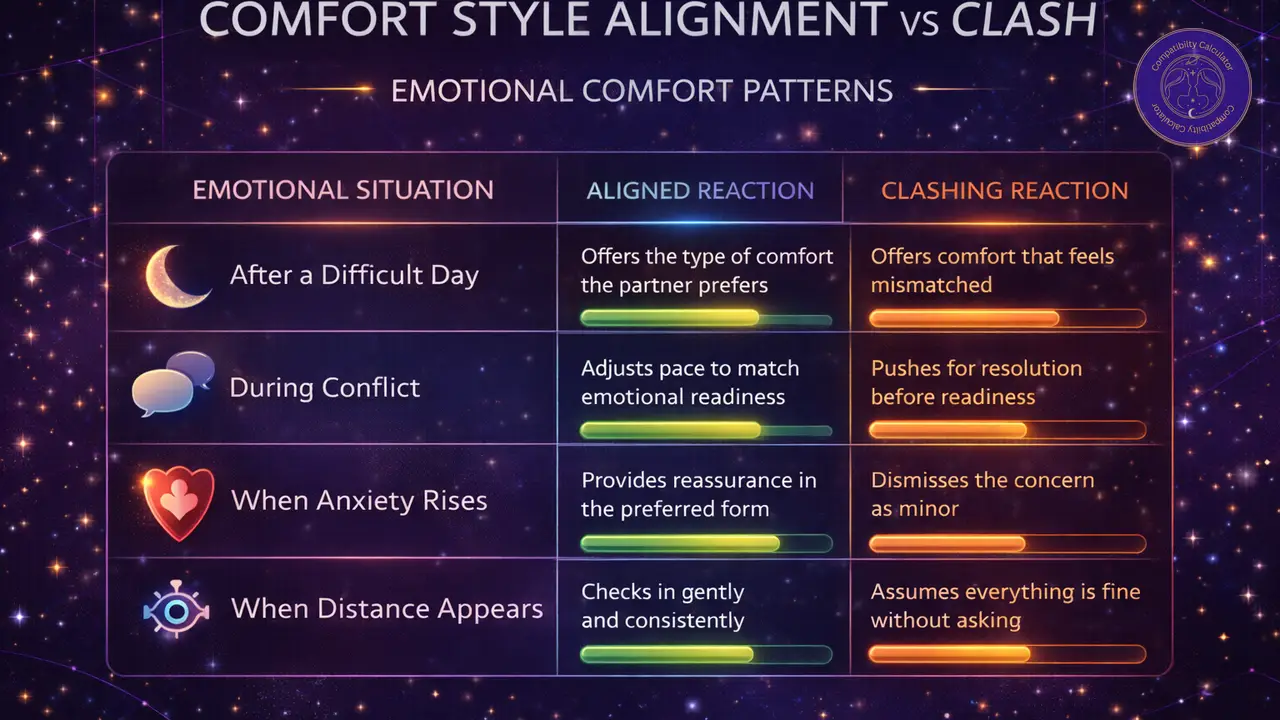
Comfort Style Alignment vs Comfort Style Clash
| Emotional Situation | Aligned Reaction | Clashing Reaction |
|---|---|---|
| After a difficult day | Offers the type of comfort the partner prefers | Offers comfort that feels mismatched |
| During conflict | Adjusts pace to match emotional readiness | Pushes for resolution before readiness |
| When anxiety rises | Provides reassurance in the preferred form | Dismisses the concern as minor |
| When distance appears | Checks in gently and consistently | Assumes everything is fine without asking |

Safety grows when both partners learn each other’s comfort language and respond intentionally instead of automatically. When reactions are adjusted with awareness, emotional trust becomes steadier even during disagreement.
Mood Cycles, Sensitivity, and Repair
Emotional compatibility is not only about comfort during stress, since it is also about how two people move through changing moods across ordinary days. In some relationships, one partner senses a shift in tone before a word is spoken and adjusts gently without making the other feel exposed. That quiet responsiveness creates a feeling of being understood without needing constant explanation.
When emotional rhythms sync, recovery after hurt happens naturally. A tense moment may still occur, yet both partners return to balance without holding on to pride or defensiveness. One may offer a soft acknowledgment, and the other may accept it without reopening the wound, which allows closeness to rebuild without dramatic effort.
When Emotional Rhythms Clash
In other relationships, mood changes are interpreted personally instead of compassionately. One partner may withdraw for space, and the other partner may assume rejection instead of reflection. A sensitive reaction may be labeled as an overreaction, and independence may be mistaken for emotional distance.
These misinterpretations slowly create insecurity because each person begins protecting themselves instead of leaning toward the other. The more protection increases, the harder it becomes to feel relaxed and emotionally open.
Moon sign needs are emotional, but they still connect with the larger planetary pattern in a relationship. The guide to planetary compatibility in relationships explains how comfort, attraction, communication, and long-term pressure can support or weaken each other.
When affection is present but emotional timing feels uneven, Venus and Mars compatibility can explain why desire does not always create comfort. A quick check through the compatibility calculator tool can also show whether the emotional score matches the rest of the relationship pattern.
Repairing Emotional Misalignment
Repair does not always require long conversations. Sometimes it begins with recognizing that the other person’s reaction comes from habit rather than hostility. When one partner says, “I know you need quiet time when you are upset,” or “I realize you need reassurance before advice,” tension softens because understanding replaces assumption.
Moon compatibility becomes strong when both partners stop judging their emotional style and start working with it. Sensitivity is no longer treated as weakness, and independence is no longer treated as coldness. Instead, both are understood as different forms of emotional self-protection that can coexist with care.
Emotional Awareness Checklist
Read these slowly and reflect on lived experience rather than ideal expectations.
- We recognize each other’s mood shifts without immediate criticism.
- We allow space when needed without assuming rejection.
- We offer comfort in the form that the other person values most.
- We return to closeness after tension without keeping silent resentment.
Moon sign compatibility becomes visible in how safe both partners feel being emotionally imperfect. When reactions are met with patience instead of judgment, vulnerability becomes easier and emotional trust deepens naturally.
A Moon sign reading becomes more useful when the score is treated as a starting point for reflection. The page on astrology compatibility calculator accuracy explains why emotional results need context, especially when two people care about each other but respond differently under stress.
Conclusion – Why Moon Sign Compatibility Feels So Personal
Emotional compatibility reaches deeper than shared interests or shared goals, because it shapes how safe you feel during your most vulnerable moments. You may admire someone’s personality and respect their ambition, yet if your emotional responses do not feel understood, closeness slowly becomes fragile.
Moon sign compatibility is not about avoiding conflict or avoiding sensitivity. It is about learning how the other person feels comforted and how they react when overwhelmed, and then responding with care instead of criticism. When two people understand each other’s emotional rhythm, everyday life feels softer and more secure, even during stressful periods.
Frequently Asked Questions
Is Sun compatibility enough without Moon sign harmony?
Strong Sun compatibility can create attraction and shared direction, yet it does not automatically create emotional safety. Without Moon harmony, partners may admire each other publicly while struggling privately with unmet comfort needs and misunderstood reactions.
Can differences in Moon signs improve over time?
Moon differences can improve when both partners become aware of their emotional habits and adjust intentionally. Growth happens when reactions are explained openly and comfort is offered in the form that actually soothes the other person, rather than in the form that feels natural to oneself.
Why do some couples feel emotionally safe despite frequent disagreements?
Emotional safety depends more on repair than on the absence of conflict. Couples who return to understanding quickly and who validate each other’s feelings during tension often feel secure, even if disagreements occur regularly.
How can you tell if emotional needs are being ignored?
Emotional needs are likely being ignored when one partner repeatedly feels unseen or unheard after expressing vulnerability. If attempts to explain feelings are dismissed or minimized instead of explored, insecurity gradually replaces trust and comfort.