A reader may arrive with two birth charts and ask why a Western comparison does not answer the same question as a Vedic match. The difference is not a matter of one system being right and the other being wrong; each tradition selects its own reference points and language for discussing a relationship.
Vedic compatibility usually refers to relationship comparison within Vedic astrology, also called Jyotish. This guide keeps that tradition separate from the site’s current Western Full Chart method. For the documented product boundary, read the Methodology page; for the number-based tradition, see the Numerology Compatibility guide.
What Vedic Compatibility Means
In traditional Vedic matching, birth information is used to place the Moon and other chart factors within a sidereal zodiac. The reading may discuss Rashi, Nakshatra and a matching framework such as Ashtakoota or Guna Milan, but those terms do not all mean the same thing.
The useful question is what a chosen method is examining. A Rashi comparison may discuss Moon-sign habits, a Nakshatra comparison may focus on the Moon’s lunar mansion, and Guna Milan may organise eight traditional Kootas into a score. A reader gets a clearer result when those layers remain named instead of being collapsed into one label.
How Vedic and Western Compatibility Differ
Western astrology commonly uses a tropical zodiac, while Vedic astrology commonly uses a sidereal zodiac. The same birth data can therefore place a planet or sign differently in the two systems. That difference is a change of reference system, not proof that one tradition is more correct.
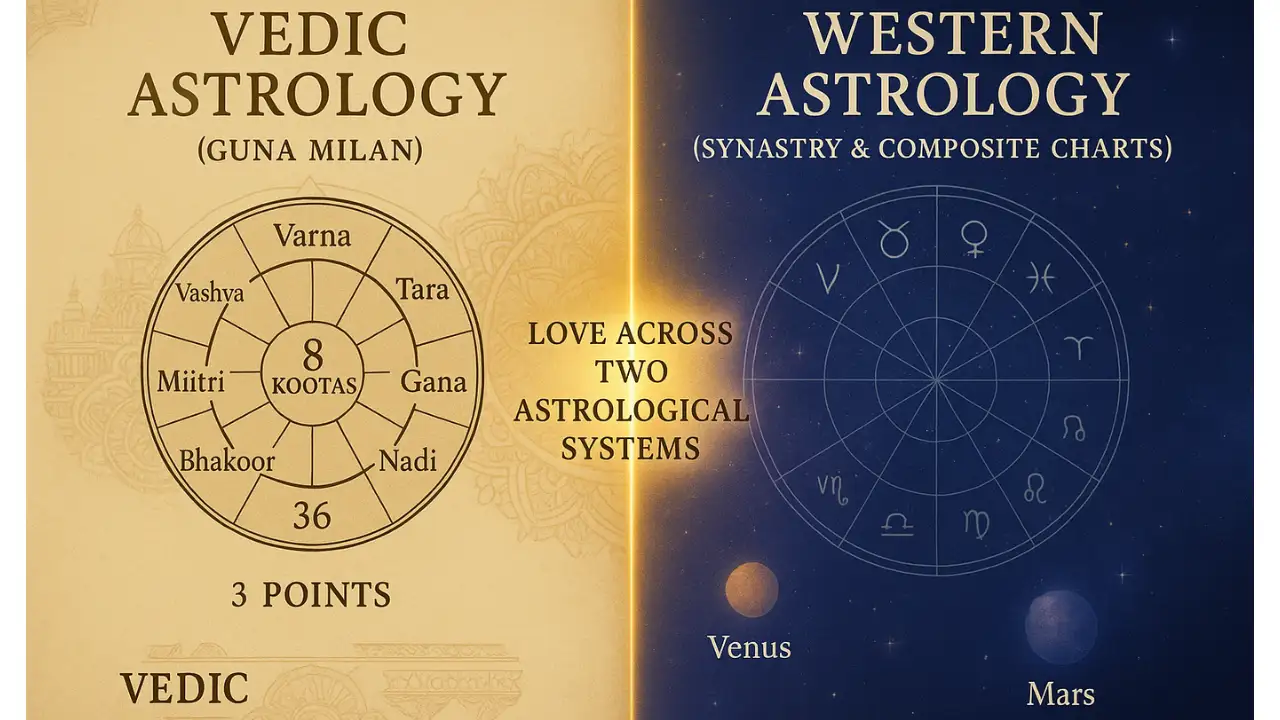
Western birth-chart compatibility may examine planets, houses and aspects between two charts, while Vedic matching may give more attention to Moon-based factors and traditional matching rules. The birth-chart compatibility guide explains the Western chart approach; it should not be read as a translation of a Vedic score.
Rashi and Moon-Based Comparison
Rashi is commonly used for the Moon sign in Vedic compatibility discussions. It is not the same as a Western Sun sign, and it is not the Ascendant. A Rashi comparison may be used to talk about instinctive responses, emotional habits and the kind of reassurance that feels familiar.
A person may share a Western Sun sign with someone else while carrying a different Rashi. That is why a Western sign description cannot be relabeled as a Moon-sign reading. The {link(‘Rashi Compatibility guide’, ‘/rashi-compatibility/’)} keeps this distinction at the centre.
Nakshatra Compatibility
A Nakshatra is a lunar mansion connected with the Moon’s position in a common Vedic framework. Traditional matching may use it to discuss instinctive habits, emotional expectations and the way two people respond when closeness or pressure changes.
Nakshatra is related to Rashi because both use the Moon’s placement, yet they describe different layers. The Nakshatra Compatibility guide explains the lunar-mansion layer without turning it into a fixed relationship verdict.
Guna Milan and Ashtakoota
Guna Milan is the score produced by the common Ashtakoota framework. Ashtakoota names eight Kootas—Varna, Vashya, Tara, Yoni, Graha Maitri, Gana, Bhakoot and Nadi—and the common structure totals 36 points.
The number organises a traditional matching exercise; it is not a probability of marriage success. A high result does not guarantee a workable relationship, and a lower result does not describe the whole of two people’s conduct. The Guna Milan and Ashtakoota guide explains what each Koota is used to discuss and where the score stops being useful.
Why Birth Details Matter
Birth date, time and place can affect the chart positions used by a Vedic practitioner. A missing or uncertain birth time may change the level of detail available, so a careful reading should state what information it used rather than present an exact chart without that context.
The current Western Full Chart mode on this site is not a hidden Vedic mode. These pages are educational foundations for a separate tradition; they do not claim that the live calculator currently calculates Rashi, Nakshatra or Guna Milan.
What Vedic Compatibility Can Describe
A traditional Vedic comparison can give a reader language for questions such as these:
- How two people may respond when emotional reassurance is needed.
- Whether daily expectations and personal pace appear easy to discuss.
- Which traditional factors a practitioner is weighing in a match.
- Where a conversation about boundaries, responsibility or family expectations needs more attention.
What It Cannot Predict
A chart or traditional score cannot observe every conversation, power imbalance, life circumstance or act of care in a relationship. It should not be used as a promise about marriage, divorce, loyalty, health or a person’s future choices.
The most responsible reading treats the method as a structured prompt. A reader can compare the description with actual behaviour, ask what evidence supports the interpretation and leave room for new information instead of treating a score as a verdict.
How This Site Keeps Vedic and Western Methods Separate
The current Full Chart method is Western astrology. Vedic pages use their own terms and traditional frameworks, while numerology pages use number-based methods. A page can explain a tradition without claiming that the live calculator has added that tradition to its score.
The Methodology page and the Sun, Moon and Rising guide describe current Western content. They do not turn Rashi into a Western Moon sign or convert Guna Milan into a percentage. The separation protects readers from comparing unlike scales.
Vedic Compatibility at a Glance
| Method | What it looks at | What it may describe | What it should not prove |
|---|---|---|---|
| Rashi comparison | Moon sign in common Vedic usage | Emotional habits and instinctive responses | A marriage verdict or fixed personality |
| Nakshatra matching | The Moon’s lunar mansion | Relationship expectations and traditional lunar themes | A fixed-partner status or guaranteed harmony |
| Ashtakoota / Guna Milan | Eight traditional Kootas | A structured matching score with named factors | Marriage probability or Western percentage |
| Western Full Chart | Tropical chart factors used by the current mode | Planetary and relationship patterns within that method | A hidden Vedic or numerology result |
Compatibility Reflection
A Vedic reading is most useful when the method is named, the birth information is clear and the interpretation returns to behaviour. If a description says a pair may struggle with reassurance or pace, the next step is a real conversation about how each person asks for support and follows through.
FAQs
Is Vedic compatibility the same as Western compatibility?
No. Vedic and Western astrology use different reference systems and may emphasise different chart factors. A result from one tradition should keep its own name and scale.
What can a high Guna score say about a relationship?
It can show that certain factors line up more favourably within the traditional framework. It cannot observe consent, communication, responsibility or the choices two people make.
Does birth time matter in Vedic matching?
It can matter when a practitioner needs chart details that depend on time and place. A reading should state what information was used and what remains uncertain when the time is not known.
Can Vedic compatibility predict divorce?
No. A traditional comparison cannot predict a future legal or relationship outcome. It may give language for discussing expectations, but real behaviour and circumstances remain outside the score.
Checklist
- Name the Vedic method before interpreting the result.
- Separate Rashi, Nakshatra and Guna Milan rather than treating them as one factor.
- Check the birth information and note any uncertainty.
- Use the reading as a conversation prompt, not a relationship verdict.