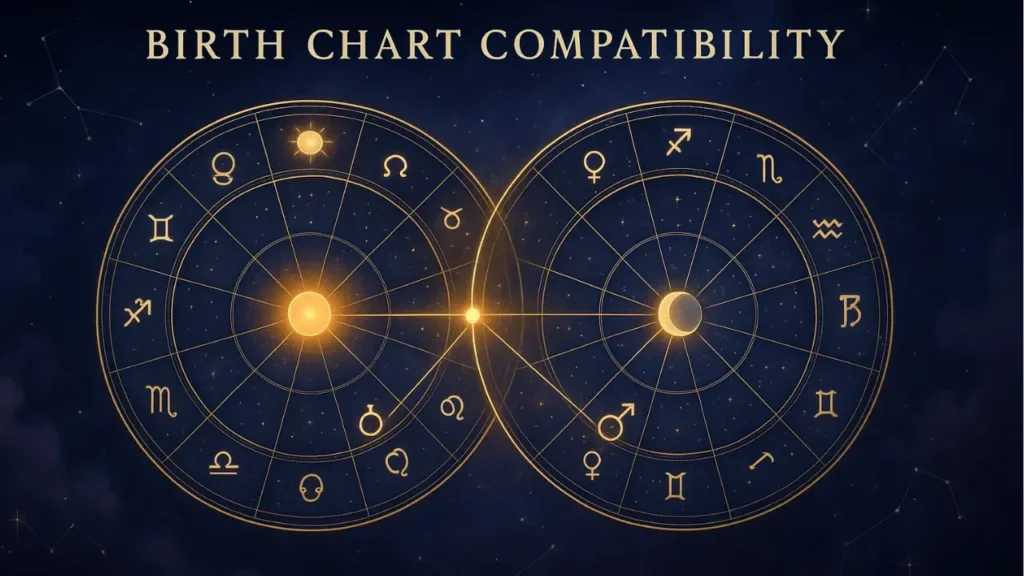
Two people can share a Sun sign and still handle reassurance, disagreement and closeness in very different ways. Birth chart compatibility looks at the wider natal chart to ask how each person’s placements interact with the other’s. That comparison is commonly called synastry.
The point is not to turn a chart into a verdict about whether a relationship will last. A synastry reading gives language for patterns such as how two people explain themselves, seek emotional safety, show affection, pursue what they want and respond when pressure rises.
This article focuses on Western birth-chart compatibility and keeps Vedic astrology and numerology as separate systems. For the current calculator’s stated inputs, outputs and method boundaries, read the Methodology. Educational coverage of a system does not mean that the system is active in every live calculator mode.
What Birth Chart Compatibility Looks At
A natal chart records the positions of the Sun, Moon and planets for a person’s birth information. Depending on the method, it can also include the Ascendant, houses and other chart points that depend on accurate birth time and location. The chart is not a personality label by itself. It is a set of placements that an astrologer interprets together.
Synastry places two natal charts side by side. The reader then checks relationships between one person’s placements and the other person’s placements. A Mercury contact may raise questions about how the pair explains an idea or repairs a misunderstanding. A Moon contact may draw attention to reassurance and instinctive reaction. Venus and Mars contacts may describe affection, attraction and different speeds of pursuit.
Synastry is not the same as a composite chart. Synastry compares the two natal charts directly. A composite chart is a separate relationship-chart technique used by some astrologers to describe the bond as its own symbolic chart. Neither method turns a relationship into a guaranteed outcome.
Why Sun Signs Alone Miss Part of the Picture
Sun-sign compatibility gives a broad view of identity, direction and the way two people may recognize one another. It can be a useful starting point, but it does not show every part of a person’s chart. Two people with compatible Sun signs may still speak past each other, need different forms of reassurance or move at different speeds when conflict appears.
The Moon adds emotional safety and instinctive response. Mercury adds speech, interpretation and the exchange of ideas. Venus and Mars add affection, attraction, assertion and conflict response. Saturn adds questions about limits, patience, responsibility and follow-through. A chart comparison uses these placements to describe a wider pattern than a Sun-sign match alone.
If you are starting with sign-level patterns, the zodiac compatibility explained guide is the better first step. Move to chart comparison when the question depends on birth details and the interaction between placements.
Sun, Moon and Rising in Compatibility
The Sun describes identity and personal direction. In a relationship reading, Sun contacts can show how each person wants to express purpose, receive recognition and take up space. They do not decide whether the pair will respect one another.
The Moon describes emotional safety and instinctive reaction. Moon contacts can show what reassurance feels like, what happens when one person feels hurt and whether the pair returns to calm in similar or different ways. A difference in Moon style is not automatically a problem; it becomes useful when it explains a pattern the two people can actually observe.
The Rising sign, or Ascendant, describes outward behavior and immediate response. It can affect first impressions, everyday rhythm and how a person meets a new situation. Because the Ascendant depends on birth time, it should be used only when the time supports it.
The current site also offers a separate Sun, Moon & Rising mode. That mode compares the signs supplied for the three placements and gives a broader sign-pattern reading. It does not claim the same degree-based synastry detail as the Full Chart mode. The current compatibility calculator shows which comparison modes are available before a reading begins.
How Synastry Compares Two Charts
An aspect is the angular relationship between two placements. In synastry, the placements belong to different people’s charts. The aspect name describes the kind of relationship between them, while the orb shows how close the actual angle is to the exact aspect.
Conjunctions
A conjunction brings two placements close together. Their themes may become hard to separate in daily life. A Sun and Mercury conjunction, for example, may connect identity and speech so closely that one person’s way of expressing a view becomes part of how the other person experiences their presence. The effect still depends on the planets involved and the behavior around them.
Sextiles and Trines
A sextile or trine can make an exchange feel more available. One person may understand the other’s pace or respond without as much explanation. That ease is useful, but it does not remove the need for honesty or follow-through. A smooth aspect describes an opening, not a promise that the pair will use it well.
Squares and Oppositions
A square can show friction that appears when two people want different things at the same time. A Mercury square, for instance, may show a recurring difference in tone, timing or interpretation. An opposition can create a pull between two poles. The pair may feel drawn to the difference and still need a clear way to negotiate it.
Squares and oppositions are not automatically bad. A difficult contact becomes more useful to read when the article connects it to behavior: who presses for an answer, who needs time, who becomes defensive and what makes repair possible.
Why Orbs Matter
The orb is the distance between an exact aspect and the actual angle between two placements. A closer aspect generally gives clearer evidence than a looser one within the permitted range. The planets involved, the aspect type and the rest of the chart still matter. A single wide contact should not outweigh a repeated pattern of closer contacts without explanation.
What Different Planets Show Between Two People
Sun and Moon
Sun contacts bring identity and direction into the interaction. Moon contacts bring instinctive response and emotional safety. Together they can show whether one person’s way of taking the lead feels reassuring, intrusive or easy to understand for the other person.
Mercury
Mercury describes speech, interpretation and exchange of ideas. Mercury contacts can show who explains through detail, who relies on tone or context and where a small misunderstanding grows. They can also show how the pair clears up meaning after a tense conversation.
Venus and Mars
Venus describes affection, attraction and the way care is expressed. Mars describes desire, assertion and conflict response. Their contacts can be interpreted through how the pair starts a connection, asks for closeness and responds when one person wants to move faster than the other.
Jupiter and Saturn
Jupiter describes optimism, perspective and expansion. Jupiter contacts can show where one person encourages the other to take a wider view. Saturn describes responsibility, limits, patience and endurance. Saturn contacts may bring steadiness, pressure or both, depending on how the pair handles expectations and repair.
Outer Planets
Uranus, Neptune and Pluto can add wider generational or transformative themes to an educational chart reading. Uranus may point to disruption or a need for independence. Neptune may raise questions about unclear expectations or idealization. Pluto may bring intensity and change. These themes should support the main reading rather than turn one outer-planet contact into a prediction.
For a planet-by-planet compatibility overview, see planetary compatibility in relationships. That topic is related to this page, but it should not replace the full synastry explanation.
Why Birth Time Matters
Birth time supports chart information that changes quickly. It is especially important for the Ascendant and for house placements. A few minutes do not carry the same consequence in every chart, so the honest explanation is that time sensitivity depends on the factor being used and the accuracy of the recorded time.
Birth date and location can still support chart information when exact time is unavailable. The reading then has a narrower base because some time-dependent placements cannot be treated as known. More input does not turn an astrology interpretation into scientific evidence, but it can change which chart details are available to discuss.
What Happens When Birth Time Is Unknown
Unknown time should not be replaced with an invented exact time. A transparent reading uses the information that can still be supported and leaves out time-dependent factors when they cannot be calculated with enough confidence. It is better to describe a narrower reading honestly than to present an uncertain Ascendant or house placement as precise.
On the current Full Chart path, exact time can be entered when known, while the Methodology page explains the current product boundary. This article uses that boundary to explain birth time, not to repeat the whole calculator specification.
What Birth Chart Compatibility Can Tell You
Synastry can give a person useful language for noticing behavior. It may raise a question about how two people speak under pressure, how reassurance is offered, how attraction is expressed or how shared plans are handled. The value is strongest when the reader can compare the interpretation with an actual conversation, recurring conflict or ordinary act of care.
The chart can also show that the same relationship has more than one layer. A pair may find conversation easy but struggle with emotional timing. They may feel strong attraction while disagreeing about responsibility. They may share a style of commitment but need different amounts of space. These tensions are not a final judgment. They are prompts for paying attention to what happens between the two people.
What It Cannot Tell You
Birth-chart compatibility cannot prove that two people will stay together, marry, separate or treat one another well. It is not a scientific relationship test, and no aspect can excuse dishonesty, coercion, poor boundaries or repeated harm.
A supportive aspect does not remove the need for communication. A difficult aspect does not command a breakup. The chart describes a symbolic framework for interpretation; the relationship is also shaped by choices, history, circumstances and behavior.
Western, Vedic and Numerology Compatibility Are Different Systems
Western birth-chart synastry compares placements in two charts and reads cross-chart aspects. It may discuss the Sun, Moon, planets, Ascendant, houses and orb closeness when those factors are available and relevant.
Vedic compatibility is a separate framework. Depending on the tradition, it may use a sidereal zodiac, Moon sign or Rashi, Nakshatra and matching methods such as Ashtakoota or Guna Milan. A Vedic result has its own factors and scale. It should not be converted automatically into a Western synastry percentage.
Numerology uses number-based interpretation, such as numbers derived from a birth date or a name under a chosen numerology method. Those numbers do not determine planetary positions. Educational coverage of numerology does not make it a hidden input to a Western chart reading.
The current Full Chart mode is documented as Western astrology. That current product statement does not remove Vedic astrology or numerology from the wider site. It simply keeps the methods named and interpreted separately.
How to Read a Synastry Result Without Overreacting to One Aspect
Start with the question the reading is meant to answer. A broad sign comparison, a Western Full Chart reading and a Vedic matching result do not use the same inputs or scale.
Next, look for a pattern rather than one dramatic contact. Check whether several placements point toward the same behavior, whether the orb is close enough to matter within the method and whether the written explanation describes an interaction you recognize.
Then bring the chart back to ordinary life. Notice how the two people listen, clarify meaning, ask for space, show care and respond after conflict. Those observations give the symbols a human context and stop one aspect from taking over the whole reading.
Finally, keep the system boundary visible. A Western synastry pattern is not a Vedic Guna score or a numerology result. If the question is how a calculator applies its current rules, read the separate astrology calculator accuracy guide, rather than asking this article to answer a different search intent.
Frequently Asked Questions
What is birth chart compatibility?
Birth chart compatibility is the comparison of two natal charts. In Western astrology, the comparison is commonly called synastry. It examines relationships between placements in one chart and placements in the other, then interprets what those contacts may describe in communication, emotional response, attraction, responsibility and daily interaction.
Is birth time required for synastry?
Birth time is required for factors that depend on the time of day, especially the Ascendant and house placements. It is not required for every chart comparison. When time is unavailable, the reading should state which factors cannot be treated as known rather than inventing an exact time.
Can synastry work without an exact birth time?
Yes, but the reading is narrower. Birth date and location can still support planetary information, while time-dependent placements may be left out. The result should not be interpreted as though an uncertain Ascendant or house placement were exact.
Which planets matter most in compatibility?
There is no single universal ranking. The Sun and Moon can bring identity and emotional safety into view. Mercury, Venus and Mars can show speech, affection, attraction and conflict response. Jupiter and Saturn can add perspective, responsibility and endurance. The answer depends on the method and the pattern across both charts.
Are squares always bad?
No. A square can show friction, but friction is not the same as failure. The useful question is what the tension looks like in ordinary behavior and whether the pair has a way to clarify, compromise and repair.
Does one difficult aspect ruin compatibility?
No. One aspect does not describe the whole relationship. Read the orb, the planets involved, the surrounding contacts and the behavior the interpretation is meant to describe. A difficult contact may name a pressure point without deciding what either person will do with it.
Is birth-chart compatibility better than Sun-sign compatibility?
It answers a different question and uses more chart information when the required birth details are available. That does not make it scientific proof. Sun-sign compatibility can introduce broad patterns, while birth-chart compatibility can discuss the interaction between Moon, Mercury, Venus, Mars, Saturn and time-supported angles.
How is a composite chart different from synastry?
Synastry compares two natal charts directly. A composite chart uses a separate technique to describe the relationship as a symbolic chart. Neither is automatically better, and neither should be treated as a guarantee about the relationship’s future.
Final Takeaway
Birth chart compatibility is most useful when it moves from symbols to observable behavior. Sun, Moon, Mercury, Venus, Mars, Saturn, aspects and birth time can give structure to questions about communication, reassurance, attraction, responsibility and repair.
Read the chart as one source of reflection, keep Western, Vedic and numerology methods separate and leave room for the evidence that appears in daily life. The way two people listen, set boundaries and respond when things become difficult still matters more than any single contact.