An astrology compatibility calculator can be useful, but its reliability has a clear limit. It can apply the rules of a chosen astrology model to the information entered, then summarize selected patterns in a score and written explanation. It cannot prove that two people will stay together, marry or separate, and it cannot turn an astrological interpretation into scientific relationship evidence.
The useful question is not “Is this percentage secretly certain?” It is “What method does the calculator use, what information does it need, what happens when information is missing, and does the explanation show where the score came from?” For the site’s current inputs, score boundaries and privacy wording, read the Methodology.
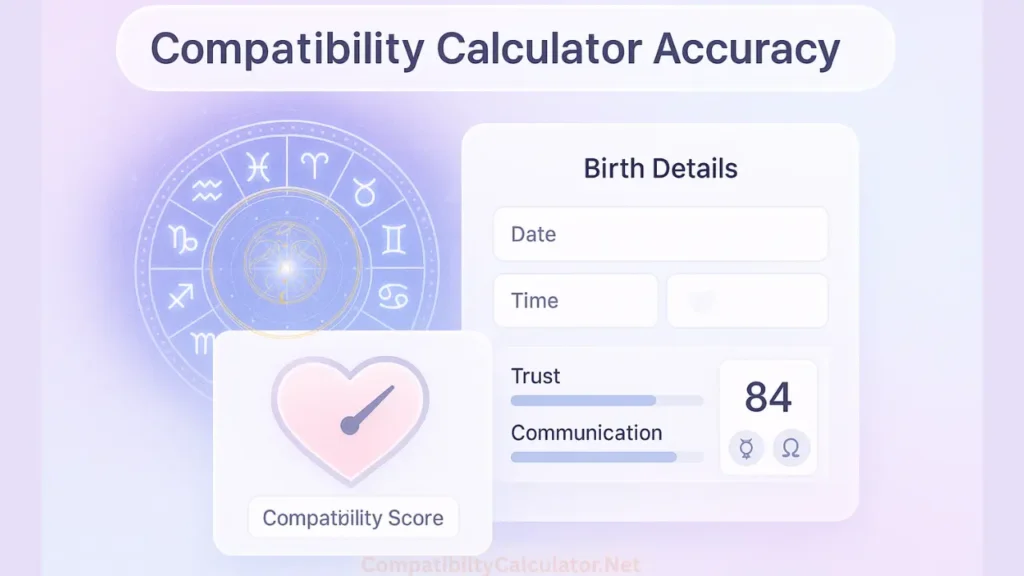
What “Accuracy” Means in an Astrology Calculator
For an astrology calculator, accuracy can mean that the system applies its stated rules in the same way when the same information is entered. It can also mean that the chart positions and aspects have been calculated from the selected method. That kind of consistency is narrower than scientific proof and different from predicting what two people will do.
A result is easier to judge when the page names its astrology system, shows the inputs it uses, explains how missing information is handled and gives the score a clear meaning. Without that context, a precise-looking percentage can sound more certain than the method supports.
What Makes a Compatibility Calculation More Consistent
Birth Date and Location
A birth date anchors the planetary positions used in a chart. Birth location supplies the place and local time context needed for chart calculation. If a tool accepts only signs or dates, it is answering a narrower question than a chart comparison that uses location and time.
Birth Time
Birth time matters for placements that change quickly, including the Ascendant. When the time is unknown, a transparent calculator should not invent an exact time. It should use the information that can still be supported and leave out time-dependent factors it cannot calculate with enough confidence.
Chart Method and Zodiac System
Western astrology and Vedic astrology use different frameworks. A Western tropical chart should not be compared with a Vedic sidereal chart as though both use the same sign positions. The method name needs to appear with the result so readers know which system they are viewing.
Aspects, Orbs and Scoring Rules
A chart comparison can examine the angular relationships between two people’s planetary positions. An aspect’s orb is the distance between the exact angle and the angle present in the charts. The permitted orb range, the planets included and the way categories are scored all affect the final summary. A public page does not need to publish private weights, but it should explain the kind of evidence the score summarizes.
Why Different Calculators Give Different Results
Two calculators can return different scores without one of them making a technical mistake. They may be answering different questions or using different conventions.
| Difference | What can change |
|---|---|
| Zodiac framework | Western tropical and Vedic sidereal calculations can place signs differently. |
| Inputs | Sun-sign comparison, supplied Big Three signs and full birth details provide different amounts of information. |
| Chart factors | One tool may include planets, houses or aspects that another leaves out. |
| Orbs and scoring | Aspect ranges, category rules and score scaling can change the final summary. |
| Missing birth time | One tool may omit time-dependent factors while another explains uncertainty differently. |
| Interpretation | Two systems may describe the same pattern with different wording or emphasis. |
Numerology results are different again because they are number-based, not planetary chart calculations. A Vedic Guna result is not automatically equivalent to a Western synastry percentage. Comparing the numbers without comparing the methods can create a false sense of disagreement or agreement.
How CompatibilityCalculator.net Handles the Current Full Chart Reading
The current Full Chart mode is documented as a Western astrology calculation. It uses a date of birth and selected birth location for each person, with exact birth time entered when it is known. Names are optional in the current flow; they can personalize the way a result is displayed, but they do not determine planetary positions.
When exact birth time is unknown, the calculator does not invent one. It uses the information that can still be supported and leaves out time-dependent factors, such as Ascendant contacts, when they cannot be calculated with enough confidence.
The current Full Chart result uses built-in astrology and scoring rules. AI is not used to determine the score in the current Full Chart mode. The separate Sun, Moon & Rising mode answers a different question by comparing the signs supplied for that reading rather than claiming to calculate the same degree-based synastry aspects as a full chart comparison. The current compatibility calculator shows which modes and inputs are available before you begin a reading.
For a broader educational explanation of chart comparison, see the birth chart compatibility guide.
The Full Chart interpretation is organized into seven areas:
| Result area | What it helps organize |
|---|---|
| Core Temperament | Basic style, direction and presence between the two people. |
| Emotional Compatibility | Reassurance, instinctive reactions and emotional safety. |
| Communication | How people exchange ideas, clarify meaning and handle misunderstanding. |
| Attraction & Chemistry | Affection, desire, warmth and differences in pace. |
| Trust & Follow Through | Responsibility, reliability, patience and shared expectations. |
| Day-to-Day Compatibility | Ordinary routines, timing, outward habits and immediate responses. |
| Growth | Ways the relationship may broaden perspective or expose a pattern that needs attention. |
These areas do not make the score scientifically accurate. They give the overall percentage more context than a single unexplained number.
What the Score Can Tell You
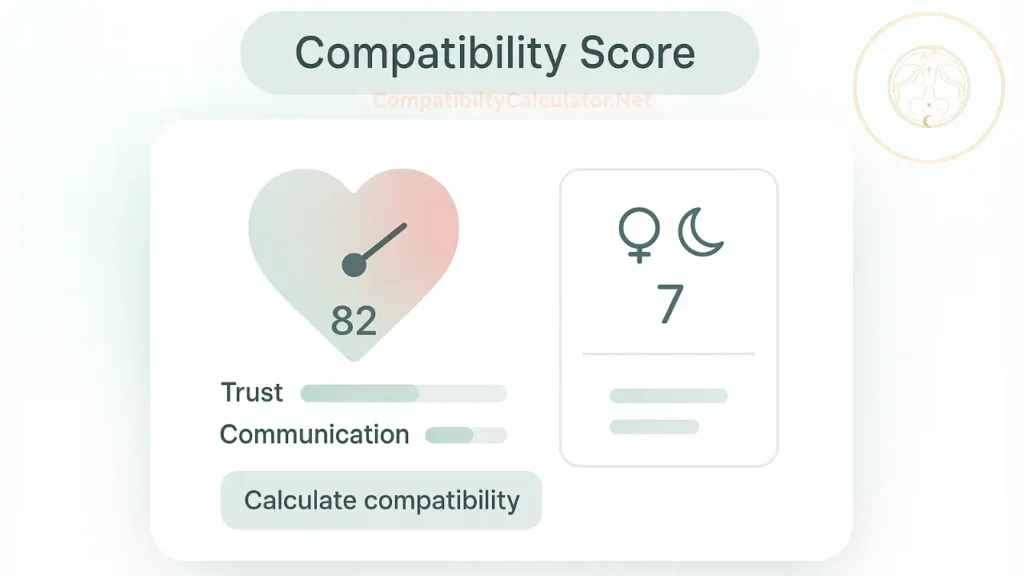
A compatibility score can summarize patterns inside the selected astrology model. The written breakdown can give you language for noticing how two people communicate, seek reassurance, respond to pressure or move at different emotional speeds.
That makes the result useful as a starting point for reflection. You can compare it with an actual conversation, a recurring conflict or the way support is offered in daily life. The value is in the question it puts in front of you, not in treating the number as a verdict.
For the narrower question of what a percentage means, read the compatibility percentage guide.
What the Score Cannot Tell You
The score is not a probability that a relationship will succeed, continue, lead to marriage or end in a breakup. It is not a scientific accuracy percentage, and it does not prove that two people are compatible or incompatible.
A high score cannot compensate for dishonesty, poor boundaries or repeated harmful behavior. A low score does not mean that two people should separate. People make choices, learn new habits, repair some conflicts and repeat others in ways that an astrology form cannot fully represent.
The Disclaimer gives additional context about the educational and entertainment limits of astrology-based results.
Western, Vedic and Numerology Results Are Different Systems
The site covers Western astrology, Vedic astrology and numerology as separate compatibility traditions.
The current Full Chart mode is a Western astrology calculation. Vedic compatibility is a distinct framework that may use sidereal signs, Rashi, Nakshatras and traditional matching methods such as Ashtakoota or Guna Milan. A traditional Guna score has its own scale and meaning; it should not be converted automatically into a Western percentage.
Numerology uses number-based interpretations. Depending on the method, it may use birth-date numbers, a Life Path calculation or name-based numbers. Those numbers do not determine planetary positions and should not be treated as hidden astrology inputs.
Educational coverage of a system does not automatically mean that the system is active in every live calculator mode. Each mode should name its inputs, scoring approach and limitations. Tarot is not part of the current Full Chart calculation.
How to Read a Result More Usefully
Start by checking which mode you used and what information you entered. If exact birth time was unavailable, remember that the reading may be narrower because some time-dependent factors were left out.
Next, read the written breakdown instead of stopping at the percentage. Notice whether the descriptions connect with observable behavior: how the two people explain themselves, respond when hurt, manage pressure or follow through on plans.
Then compare the interpretation with real evidence from the relationship. A score can suggest a question about communication or emotional pacing, but the conversation and the behavior that follow are more useful evidence about the relationship itself.
Finally, keep the method boundary visible. A Western Full Chart result is not a Vedic Guna score or a numerology result, and none of these outputs is a guarantee about the future.
When a Human Astrologer May Add More Context
A human reader may ask questions that a calculator form does not contain. They may consider relationship history, current life stage, priorities, recurring behavior and the concern that brought someone to the reading.
That can make a conversation more personally relevant, especially when the reader needs to decide what to ask or discuss next. It does not mean that a human reading is scientifically proven to predict outcomes, and it should not be described as accurate by a guaranteed percentage.
The practical difference is context. A calculator applies its defined rules to its available inputs. A human conversation can explore what those patterns mean in the lives of the people involved. For a direct comparison of online calculator matching and broader professional readings, see our guide to calculator and professional readings.
Frequently Asked Questions
Are astrology compatibility calculators accurate?
They can be consistent in applying the rules they state, but consistency is not the same as scientific accuracy or relationship prediction. Review the method, inputs, birth-time handling, scoring explanation and limitations before deciding how much weight to give a result.
Why do different compatibility calculators give different scores?
They may use different zodiac systems, chart factors, aspects, orb ranges, missing-time rules, scoring models or interpretation styles. A Sun-sign reading, a Western Full Chart reading, a Vedic matching result and a numerology result should not be expected to use the same scale.
Does exact birth time matter?
It matters when the calculation depends on the Ascendant or another time-dependent chart factor. If the exact time is unknown, a transparent calculator should not invent one; it should use the supported information and leave out factors it cannot calculate confidently.
Is a full birth chart better than Sun signs alone?
It gives more chart detail and can answer a different question, but more detail is not the same as scientific proof. A full chart comparison is useful when the method, inputs and limitations are clearly explained; a sign-level reading can still be appropriate for a broad introduction.
Can a low score still describe a workable relationship?
Yes. A low score is not a command to end a relationship, and a high score is not a guarantee that it will work. Communication, consent, reliability, boundaries and repair after conflict remain more important than a single percentage.
Final Takeaway
An astrology compatibility calculator is easiest to use responsibly when its method is visible and its claims are limited. Check the inputs, notice how missing birth time is handled, read the category breakdown and keep Western, Vedic and numerology systems separate.
The result can organize reflection, but it cannot make the relationship decision for you. Real compatibility is also visible in how two people speak, listen, set boundaries and behave when the easy part is over.