An online calculator and a human astrology reading answer different kinds of questions. A calculator applies its built-in rules in a repeatable format; a human reader can ask follow-up questions and discuss the story around the chart. Neither format can prove that a relationship will succeed or fail.
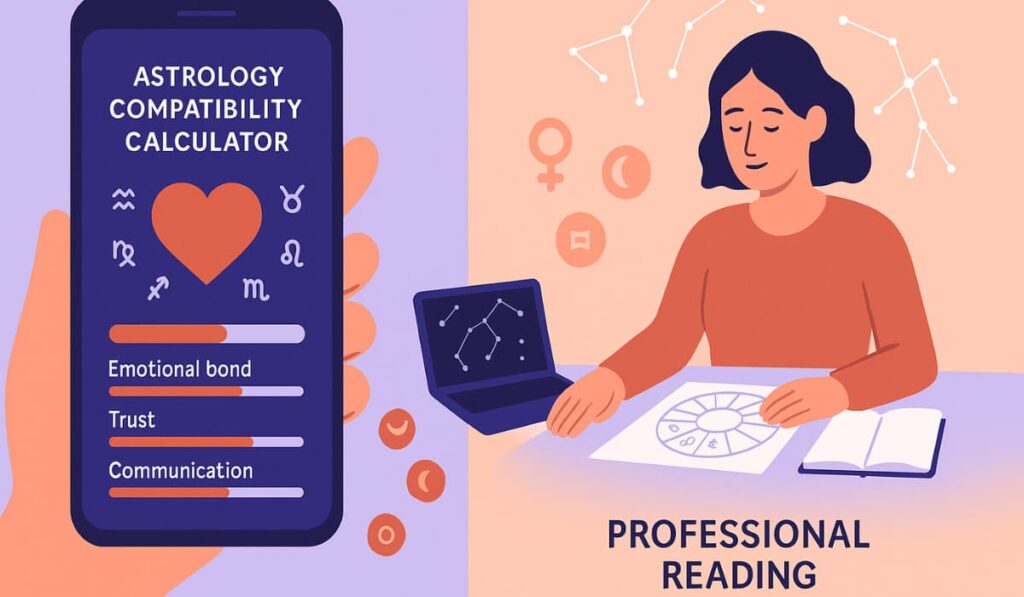
What an Astrology Calculator Does Well
The current CompatibilityCalculator.net calculator gives a structured entry point. Full Chart uses Western astrology and works from birth date, selected location and birth time when known; the result separates Core Temperament, Emotional Compatibility, Communication, Attraction & Chemistry, Trust & Follow Through, Day-to-Day Compatibility and Growth.
- It applies the same stated rules each time the same inputs are used.
- It gives a quick, repeatable comparison in a predictable format.
- It lets a reader inspect separate result areas instead of relying on one vague sentence.
- It gives a starting point for questions about communication, reassurance, timing or practical routines.
What a Human Reading May Add
A human reader can ask what happened during the disagreement, whether a pattern repeats and what each person wants to understand. The reader can explain symbolism in conversation, notice which part of a chart matters to the question and adjust the discussion when new context appears.
That personal context is the main difference, not automatic proof of accuracy. Practitioners use different traditions, training and interpretive habits, so two readings may not sound alike.

Where a Calculator Is More Consistent
| Question | Calculator | Human reading |
|---|---|---|
| How are inputs handled? | The same built-in rules apply to the entered data. | The practitioner may ask for context and decide which details to discuss. |
| What does the reader receive? | A repeatable percentage and written result areas. | A conversation shaped around the question and the practitioner’s method. |
| What happens next? | The reader interprets the output and checks it against real behavior. | The reader can ask follow-up questions during the session. |
| What is the main limit? | The format cannot know the full story behind the inputs. | Interpretation may differ between practitioners and still cannot prove an outcome. |
Where Human Context Can Matter
A chart description may sound different when one person is dealing with grief, a new job, a recent betrayal or a disagreement about money. A human conversation can hold that context in the room. The calculator can still give language for a pattern, but it cannot verify what either person intends or does next.
What Neither Can Prove
- Neither can prove marriage, breakup, divorce or relationship success.
- Neither can guarantee that a person will be honest, kind, faithful or safe.
- Neither can replace direct communication, consent, boundaries or professional support when a serious risk is present.
- Neither turns a score or interpretation into a command about what someone must do.
Which One Fits the Question You Are Asking
A calculator fits a first comparison, a repeatable format or a private moment of reflection. A human reading fits a question that needs follow-up, context and conversation. Some readers use the calculator first and then bring a narrower question to a practitioner; that order is a preference, not a requirement.
The birth chart guide explains chart-level concepts, while the accuracy article explains why neither a score nor a reading should be treated as scientific proof.
Frequently Asked Questions
Are professional readings automatically more accurate?
No. A human reading adds context and conversation, but the method, practitioner and interpretation still matter. A professional label is not proof of an outcome.
Is a calculator better than a human reading?
Neither is universally better. A calculator gives repeatability and a defined format; a human reader can ask follow-up questions and discuss context.
Can either option predict relationship success?
No. Neither can guarantee marriage, breakup, good treatment or relationship success.
What should I bring into a reading?
Bring a clear question and the real situation you want to understand. The chart should remain a framework for reflection, not a substitute for evidence and conversation.