Seeing a percentage beside a compatibility result can make a broad interpretation feel more exact than it is. The useful question is not whether 70% means a relationship will work. It is what the selected compatibility model included, what the number summarizes and where the written breakdown adds detail.
A compatibility percentage is a summary inside the selected compatibility model. It may reflect more supportive patterns than friction among the factors included by that method, but it is not a scientific accuracy measure, relationship-success probability, marriage probability or breakup probability.
Before interpreting the number, check which comparison mode produced it. The current compatibility calculator offers more than one way to compare two people, and different modes can use different inputs and scales. For the current inputs and boundaries documented for the live product, read the Methodology.
What a Higher Score Means
A higher score means that the selected model found more supportive patterns relative to friction among the factors it includes. That may point to easier exchanges in one area, more familiar emotional pacing or fewer pressures within the model’s chosen inputs.
It does not mean that the relationship will be easy, that the two people are a perfect match or that conflict will not appear. A high number still needs to be read alongside the written explanation and compared with how the two people actually communicate, respond under pressure and follow through.
What a Lower Score Means
A lower score means that the selected model found more friction or fewer supportive patterns among its included factors. The result may give a reader a useful question about communication, reassurance, attraction, responsibility or daily rhythm.
It does not mean that the relationship is bad, that the people are incapable of caring for one another or that they should separate. A score cannot see every choice, habit, circumstance or repair attempt that shapes a relationship.
Why the Written Breakdown Matters
A total percentage compresses several observations into one number. The category breakdown gives those observations somewhere to go. It can show whether the summary is being driven by communication, emotional safety, attraction, responsibility, ordinary routines or a theme that needs more attention.
When the current Western Full Chart mode is selected, its result is organized into seven public areas. These labels belong to this calculator’s presentation; they are not universal categories shared by every Western, Vedic or numerology method.
| Current result area | What it helps organize |
|---|---|
| Core Temperament | Basic style, direction and presence between the two people. |
| Emotional Compatibility | Reassurance, instinctive reactions and emotional safety. |
| Communication | How the pair exchanges ideas, clarifies meaning and handles misunderstanding. |
| Attraction & Chemistry | Affection, desire, warmth and differences in pace. |
| Trust & Follow Through | Responsibility, patience, reliability and shared expectations. |
| Day-to-Day Compatibility | Ordinary routines, timing, outward habits and immediate responses. |
| Growth | Ways the relationship may broaden perspective or expose a pattern that needs attention. |
The labels do not turn the score into a diagnosis. They help explain which part of the result deserves a closer look. If the communication area is lower, the useful next question is what happens when one person needs detail and the other needs time. If trust or follow-through is lower, look at promises, expectations and what happens after a plan changes.
Why a Percentage Can Feel Convincing
A score can feel accurate when the wording describes a pattern the reader already recognizes. Broad relationship language may also invite people to notice the examples that fit more readily than the ones that do not. That reaction does not prove that the number predicts what will happen next.
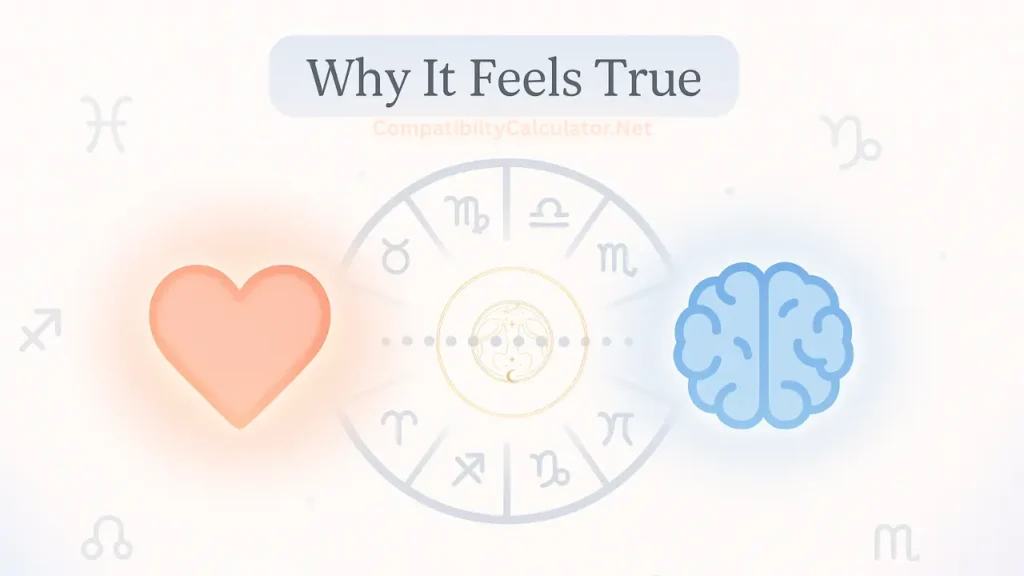
The most useful test is practical. Read the explanation, identify the behavior it describes and compare it with an actual conversation, recurring disagreement or ordinary act of care. If the wording does not match the relationship, the percentage should not overrule what the two people can observe.
Why Two Compatibility Percentages May Differ
Two calculators can return different percentages without one number being a universal correction of the other. They may use a different compatibility method, different inputs, different chart factors, different scoring rules or a different way of handling missing birth time. Western astrology, Vedic matching and numerology also ask different questions and use different scales.
The mode matters as much as the number. A sign-level comparison does not summarize the same information as a Western Full Chart result, and a Vedic Guna result is not a translated Western percentage. For the broader question of calculator consistency, inputs and method limits, read the astrology calculator accuracy guide.
Western, Vedic and Numerology Scores Are Not Interchangeable
Western compatibility results summarize patterns inside the selected Western astrology model. Vedic compatibility uses a separate framework that may involve a sidereal zodiac, Moon sign or Rashi, Nakshatra and traditional matching methods such as Ashtakoota or Guna Milan. Numerology uses number-based interpretations, such as numbers derived from a birth date or a name under a chosen numerology method.
That difference matters when a reader sees two numbers. A Vedic result such as 27 out of 36 Guna points should not be relabeled as 75% Western compatibility. A numerology result should not be treated as a planetary score, and a Western percentage should not be presented as a universal measure for every system.
The site can cover all three traditions educationally while keeping their score meanings separate. The availability of an educational topic does not automatically mean that it is part of every live calculator mode.
How to Read a Compatibility Result
- Check the method first. Note which comparison mode produced the number and what information it used. A score has no useful context without its method.
- Read the category breakdown. Look for the areas that support the total and the areas that create pressure. The written explanation is where a broad number becomes a more specific question.
- Look for repeated themes. One category or one sentence should not decide the reading. Notice whether the same pattern appears in communication, emotional response, attraction, responsibility or daily life.
- Compare the wording with real behavior. Watch how the two people listen, clarify meaning, ask for space, show care and respond after conflict. Use the score to organize reflection, not to make the relationship decision for you.
What a Compatibility Percentage Cannot Tell You
A percentage cannot prove that two people will stay together, marry, separate or treat one another well. It cannot measure consent, honesty, boundaries, personal safety, life circumstances or the effort someone is willing to make after harm.
A high score does not excuse repeated disrespect. A low score does not command a breakup. The number is one summary inside a selected system; the relationship is also shaped by choices and behavior that no score can settle in advance.
The Disclaimer provides additional context for reading astrology-based results without treating them as guarantees about future events.
For readers who want the chart-level explanation behind factors such as planets, aspects and birth time, see the birth chart compatibility guide. This page stays focused on how to read the number rather than repeating a full synastry lesson.
Frequently Asked Questions
What does a 70% compatibility score mean?
A 70% result means that the selected compatibility model summarized the included factors at 70 on its own scale. It does not have one universal meaning across every calculator, and it does not mean that a relationship has a 70% chance of succeeding.
Is 90% compatibility a guarantee?
No. A high score means that the selected model found more supportive patterns relative to friction among the factors it includes. It cannot guarantee a lasting relationship, marriage or good treatment between two people.
Is a low compatibility score bad?
No. A lower score indicates more friction or fewer supportive patterns within the selected model. It is a prompt to read the category breakdown and compare the description with real behavior, not a judgment that the relationship is bad.
Can two people with a low score stay together?
Yes. A score does not control what people choose or how they learn to communicate, set boundaries and repair conflict. A low result may identify a pressure point, but it cannot decide whether the relationship is workable.
Why do two calculators give different percentages?
They may use different systems, inputs, chart factors, missing-time rules or scoring scales. Compare the method and the written explanation before treating the numbers as if they were measuring the same thing.
Can Vedic Guna scores be converted into percentages?
Not automatically. Guna or Ashtakoota results have their own factors and scale within a Vedic matching framework. They should not be converted into a Western synastry percentage unless a specific future method publicly defines and explains that conversion.
Should I trust the percentage or the written interpretation?
Read them together, but give the written interpretation the job of explaining the summary rather than treating either one as a relationship verdict. Then compare the described pattern with what the two people actually do, especially when the relationship is under pressure.
Final Takeaway
Use a compatibility percentage as an index into the explanation below it. Check the method, notice what the category breakdown emphasizes and keep Western, Vedic and numerology scores on their own scales.
The most useful result is not the one that makes the biggest promise. It is the one that helps a reader ask a clearer question about communication, emotional safety, attraction, responsibility or repair—and then look for the answer in real behavior.