How Two People Function Together
A relationship shows its strength through daily interaction rather than through initial attraction, because behavior during ordinary moments reveals compatibility more clearly than early excitement. Two people may feel strong chemistry at first, yet the way they speak, react, and adjust to each other determines whether the connection remains comfortable.

In real life, compatibility appears in small repeated patterns. The pace at which each person moves, the tone used during disagreement, and the way emotional needs are expressed shape the overall atmosphere of the relationship.
Interaction Rhythm and Energy Match
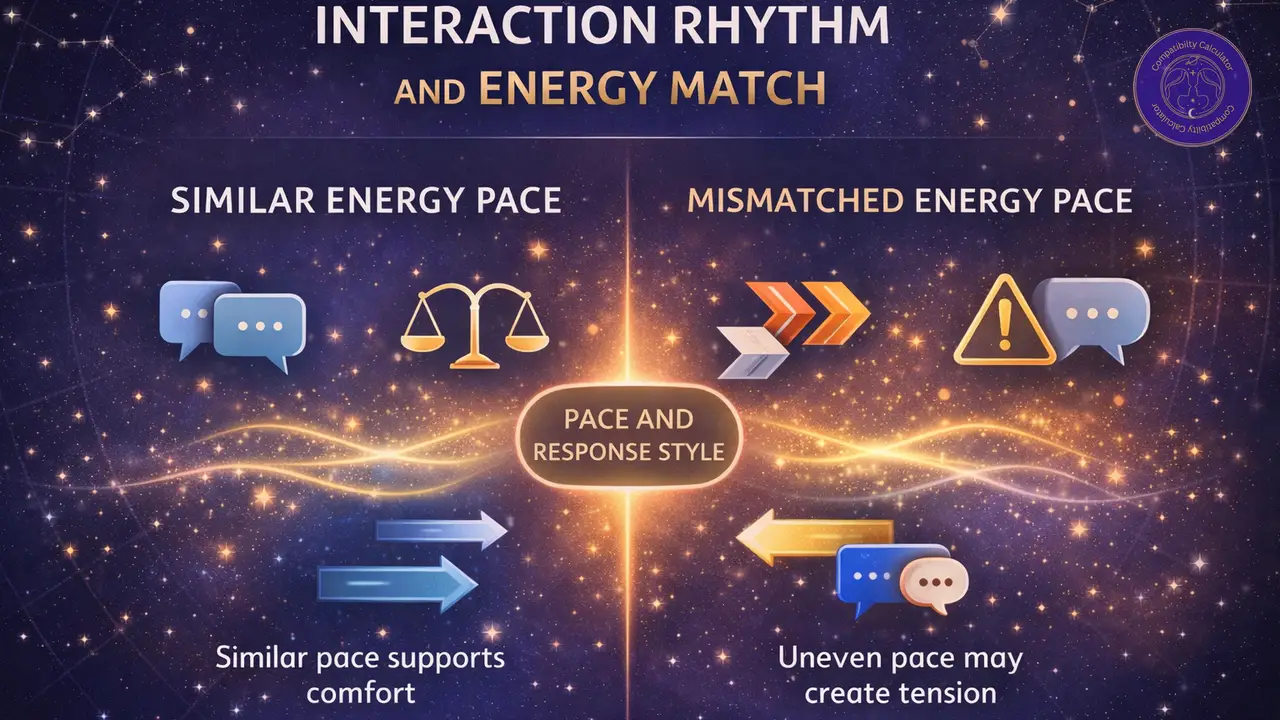
An energy match becomes visible when two people share a similar pace in conversations and planning. If one partner prefers immediate action while the other prefers reflection, frustration may develop unless both understand the difference.
A fast moving partner may interpret hesitation as a lack of interest, while a slower partner may interpret urgency as pressure. Comfort increases when both partners recognize how the other operates and adjust without criticism.
- Similar energy level supports smooth interaction.
- Uneven pace may create tension.
- Direct response may overwhelm a reflective partner.
- Reflection may frustrate an impatient partner.
Daily Interaction Table
| Area | Harmonious Pattern | Strained Pattern |
|---|---|---|
| Energy level | Similar pace | Uneven pace |
| Conversation rhythm | Balanced | Interrupted or rushed |
| Decision timing | Cooperative | Conflicting |
| Reaction speed | Comparable | Mismatched |

Emotional Comfort and Reaction Pattern
Emotional comfort determines whether vulnerability feels safe inside a relationship. A partner who expresses feelings openly may expect immediate reassurance, while a partner who processes internally may need time before responding.
When emotional styles differ, misunderstanding can grow if silence is interpreted as indifference. Security increases when both partners explain how they react during stress instead of assuming intention.
- Open expression requires understanding.
- Quiet processing requires patience.
- Reassurance style must feel sufficient.
- Emotional withdrawal needs discussion.
Emotional Response Table
| Area | Stable Pattern | Unstable Pattern |
|---|---|---|
| Reaction to stress | Explained clearly | Misinterpreted |
| Reassurance | Given and received | Requested repeatedly |
| Vulnerability | Accepted | Criticized |
| Silence | Understood | Resented |
Attraction Versus Compatibility
Attraction may create immediate excitement, yet compatibility becomes visible through repeated interaction over time. A couple may feel a strong desire and still struggle with a tone difference or expectation mismatch.
Consistency of respect and effort supports compatibility more than intensity alone. A relationship grows stronger when habits align, and misunderstandings are addressed early.
- Attraction may be instant.
- Compatibility develops gradually.
- Chemistry does not prevent conflict.
- Stable habits build comfort.
Relationship Compatibility Snapshot
At this stage, compatibility depends on interaction rhythm, emotional comfort, and repeated behavior patterns. When energy pace aligns and emotional responses are understood, the connection becomes steadier and misunderstanding reduces.
- Interaction rhythm: Energy match.
- Emotional comfort: Reaction clarity.
- Communication tone: Mutual understanding.
- Early stability: Habit consistency.
Relationship compatibility changes depending on the kind of bond being tested. A romantic match may need the deeper context from love compatibility in astrology, while a serious commitment often needs the steadier lens of marriage compatibility in astrology.
Close friendships can follow similar patterns even when romance is not involved. The guide to friendship compatibility in astrology helps separate emotional loyalty from romantic expectation.
Trust, Communication, and Conflict Development
Trust grows through repeated behavior rather than through promises, because consistency in small actions shapes emotional security more than dramatic gestures. A partner may speak about loyalty, yet reliability becomes visible through punctuality and honesty.
Over time, communication patterns begin to influence how secure each person feels inside the relationship. Tone during disagreement, listening habits, and willingness to clarify misunderstanding determine whether tension reduces or increases.
Trust Development Over Time
A sense of trust develops when behavior remains predictable during stress as well as during comfort. If reassurance appears only during conflict, insecurity may return quickly after the issue passes.
Repeated honesty builds confidence gradually, while inconsistency weakens confidence even if affection remains present. Emotional stability increases when words and actions match.
- Consistent behavior strengthens trust.
- Repeated delay weakens confidence.
- Honest admission repairs mistakes.
- Avoidance increases doubt.
Trust Pattern Table
| Area | Stable Pattern | Risk Pattern |
|---|---|---|
| Reliability | Predictable | Inconsistent |
| Transparency | Open | Guarded |
| Accountability | Accepted | Deflected |
| Emotional security | Growing | Uncertain |
Communication Under Stress
During calm periods, conversation may feel easy and cooperative. Under pressure, differences in tone and reaction speed become more visible.
A direct communicator may address the issue immediately, while a reflective communicator may need space before responding. Frustration grows if either partner assumes intention instead of asking for clarification.
- Direct tone may appear harsh.
- Indirect tone may appear evasive.
- Quick reaction may escalate the argument.
- Delayed response may increase tension.
Communication Response Table
| Area | Functional Pattern | Strained Pattern |
|---|---|---|
| Listening | Attentive | Defensive |
| Tone | Controlled | Reactive |
| Timing | Coordinated | Conflicting |
| Resolution | Completed | Repeated |
How Conflict Develops Gradually
Conflict rarely begins with a major issue, because small repeated frustrations usually accumulate first. A minor complaint that remains unaddressed may return in stronger form later.
When disagreement repeats without repair, resentment begins to replace patience. Stability returns only when both partners accept responsibility for their part instead of focusing only on the other.
- Minor issues accumulate over time.
- Repeated criticism increases irritation.
- Responsibility acceptance reduces tension.
- A clear apology restores calm.
Relationship Compatibility Snapshot – Part II
At this stage, compatibility depends on trust stability, communication under stress, and repair after disagreement. When behavior remains consistent and tone remains respectful, emotional security strengthens instead of weakening.
- Trust level: Behavioral consistency.
- Communication pattern: Tone control.
- Conflict repair: Accountability present.
- Emotional security: Stability maintained.
Long-term compatibility also shows up in practical settings where pressure is shared. The guides to career and business partner compatibility in astrology and family compatibility in astrology explain how the same patterns can appear through work, responsibility, and daily roles.
Some bonds feel exciting early but become harder when routine begins. The page on short-term attraction vs long-term relationship compatibility is useful when a connection feels strong at first but needs a clearer test over time.
Growth, Stability, and Long Term Direction
Over time, a relationship begins to reveal whether compatibility can support growth through changing circumstances rather than only through moments of comfort. As responsibilities increase and life conditions shift, each partner’s ability to adapt without resentment becomes a clear indicator of relational strength.
In developing partnerships, personal growth does not pause simply because two people are connected, and differences in ambition, maturity, or lifestyle preference may surface more clearly after the early stage of bonding has passed. When both individuals respect each other’s development and allow space for evolution, tension reduces, and cooperation becomes more natural.
Identity Direction and Personal Space
A healthy relationship maintains closeness while still protecting individual identity, because excessive control or emotional dependence can slowly weaken mutual respect. When personal goals remain acknowledged and supported, attachment feels secure instead of restrictive.
In situations where one partner attempts to limit the other’s independence out of fear or insecurity, frustration may build gradually, and emotional distance may follow. Stability increases when boundaries are discussed clearly, and expectations remain realistic.
- Personal ambition should be respected within the relationship.
- Emotional closeness should not replace individual identity.
- Space should be understood as balance rather than rejection.
- Boundaries should be explained without accusation.
Identity and Space Table
| Area | Healthy Pattern | Risk Pattern |
|---|---|---|
| Personal goals | Encouraged | Restricted |
| Independence | Respected | Controlled |
| Emotional closeness | Comfortable | Dependent |
| Boundaries | Clear | Confusing |
Growth Alignment Over Time
As years pass, compatibility depends not only on attraction or trust but also on the willingness to adjust during change. A relationship that adapts during career shifts, relocation, or emotional challenges demonstrates maturity beyond early affection.
When growth pace differs significantly, comparison or competition may replace encouragement, and subtle tension may increase unless communication remains open and supportive. Progress feels steadier when both partners acknowledge that change is natural rather than threatening.
- Change should be discussed openly before tension builds.
- Personal development should not create rivalry.
- Adjustment should feel mutual rather than forced.
- Support should remain visible during the transition.
Growth Stability Table
| Area | Aligned Pattern | Strained Pattern |
|---|---|---|
| Personal growth | Cooperative | Competitive |
| Communication | Clear | Reactive |
| Effort | Mutual | Uneven |
| Stability | Adaptive | Resistant |
Indicators of Long-Term Compatibility
Long-term compatibility becomes visible through consistency in respect, reliability in effort, and maturity during disagreement rather than through intensity alone. When conflict leads to repair instead of repetition, emotional confidence strengthens gradually.
A relationship weakens when avoidance replaces discussion and when responsibility remains one sided for extended periods. Stability increases when both partners accept accountability and demonstrate willingness to improve behavior.
- Respect remains visible in daily interaction.
- Effort remains consistent across situations.
- Conflict ends with resolution rather than silence.
- Accountability is accepted without defensiveness.
For a practical check, the compatibility calculator tool can give a quick overview before you study each relationship layer separately. The guide to astrology compatibility calculator accuracy also explains how to read the result without ignoring context.
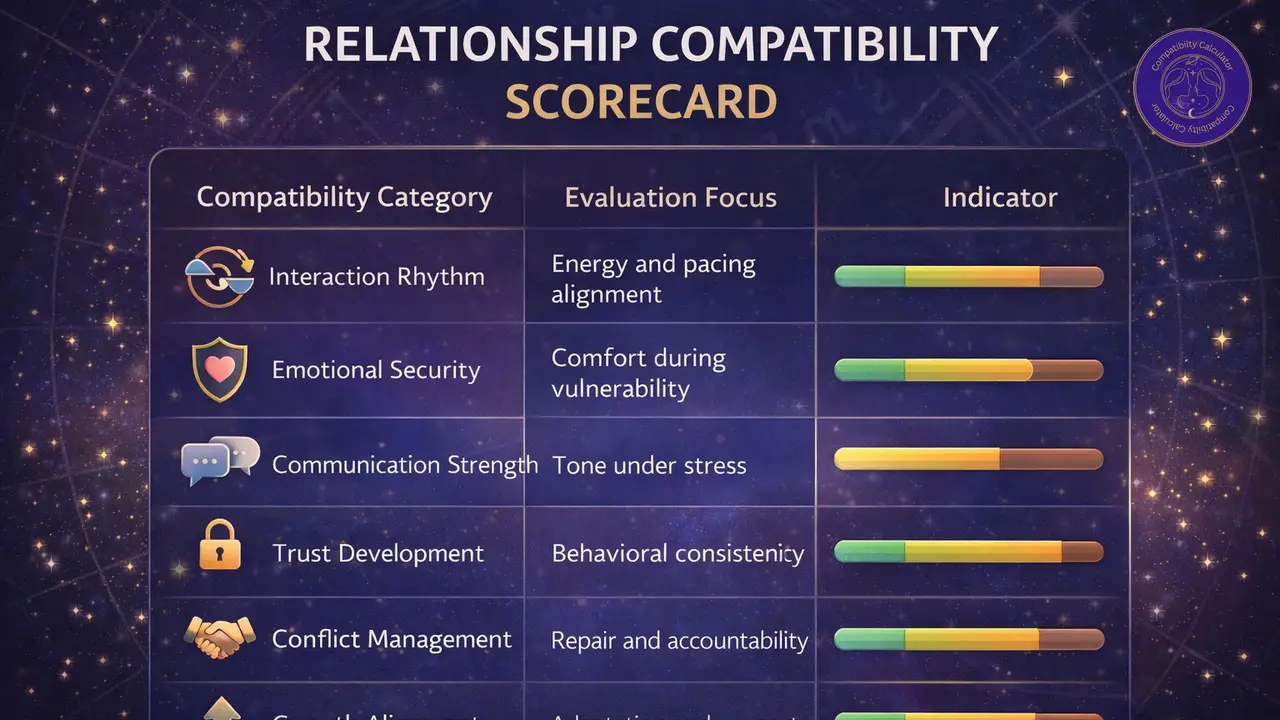
Full Relationship Compatibility Scorecard

| Category | Evaluation Focus |
|---|---|
| Interaction Rhythm | Energy and pacing alignment |
| Emotional Security | Comfort during vulnerability |
| Communication Strength | Tone and clarity under stress |
| Trust Development | Behavioral consistency |
| Conflict Management | Repair and accountability |
| Growth Alignment | Adaptation and support |
Reflection
A relationship grows stronger when both individuals feel understood, respected, and supported during change rather than controlled or criticized. If repeated tension appears around independence, reassurance, or responsibility, careful observation of behavior patterns becomes necessary before deeper commitment develops.
Honest evaluation of interaction rhythm, emotional comfort, and trust stability helps determine whether compatibility supports continued growth or requires adjustment.