Emotional Safety and Trust in Astrology Compatibility

Emotional Safety Shows Up in Small Moments

Emotional safety does not begin with big promises about loyalty or forever, since it begins in ordinary conversations where one person shares something personal and the other person reacts in a way that either feels respectful or feels dismissive. When that first response feels safe, the same person usually speaks openly again, and when that response feels sharp or careless, the same person usually edits their feelings the next time.

Emotional safety and trust in astrology compatibility shaped by daily behavior, reassurance, consistency, and emotional security.
Emotional safety usually becomes visible through small repeated behaviors, not only through words.

Many couples feel close during good days because the mood is light and the talk is easy, but real safety shows itself on uncomfortable days when disagreement appears, and emotions feel raw. When you disagree and still feel steady, and when you admit insecurity and still feel respected, the relationship begins to feel safe in a way that goes beyond comfort.

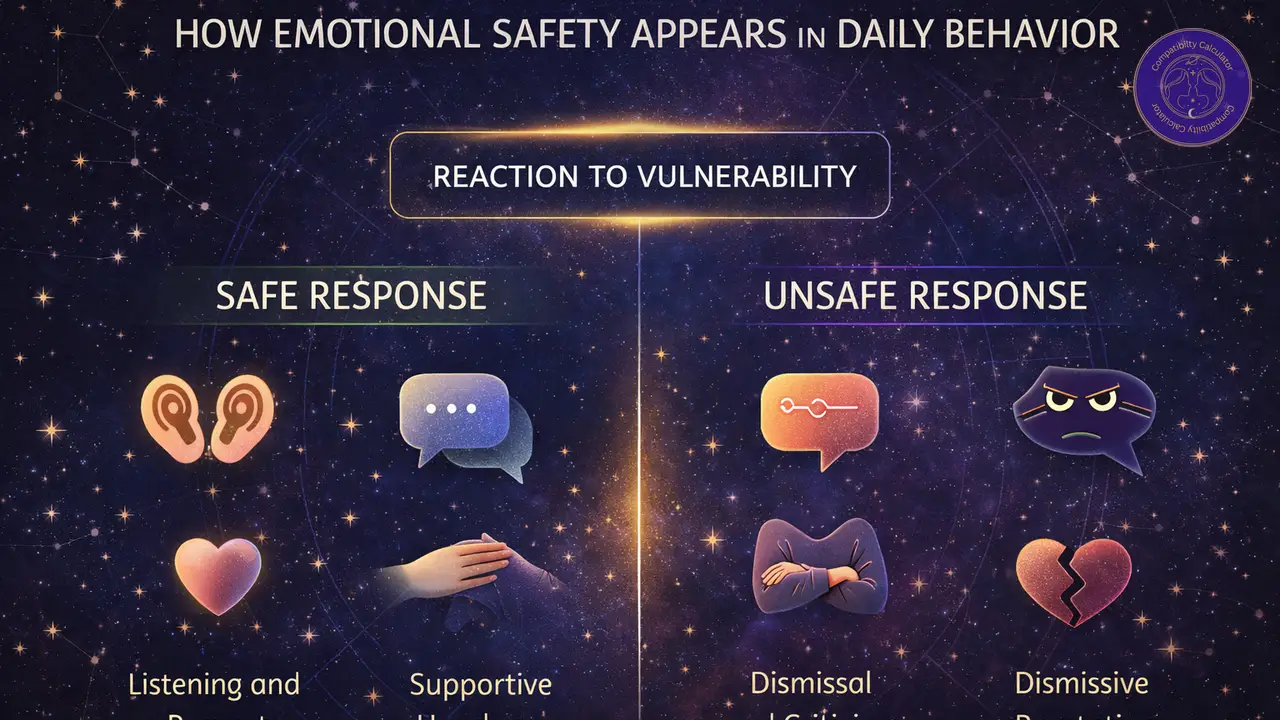
How Emotional Safety Appears in Daily Behavior

You can recognize emotional safety through behavior that repeats in small ways, and that is why everyday reactions matter more than big romantic lines.

  • One partner says, “That hurt me,” and the other partner listens with attention rather than rolling eyes or changing the topic.
  • One partner admits, “I felt insecure,” and the response stays kind instead of turning into criticism.
  • One partner makes an error and hears a correction without humiliation, because the focus stays on the behavior and not on the person’s worth.
  • One partner disagrees openly and still receives normal warmth afterward, due to which honesty does not feel risky.

These moments may look small from the outside, yet they create calm inside the relationship because honesty does not lead to punishment, and repair feels possible.

How Emotional Safety Gets Damaged Quietly

Emotional safety gets damaged through tone, timing, and repetition, because even one sharp reaction can stay in memory when it happens during vulnerability.

  • One partner uses sarcasm when the other speaks seriously, which teaches the other person to hold back.
  • One partner repeats private disclosures during later arguments, due to which personal sharing starts to feel unsafe.
  • One partner becomes cold for days after a disagreement, and the silence begins to feel like pressure instead of space.
  • One partner compares the other to someone else during conflict, and the comparison lands like rejection, even if it is framed as a joke.

Each reaction sends a message even when nothing is said directly, and the message is usually clear, as you know. “Be careful what you share” becomes the hidden rule, and then openness reduces over time.

Safety Building Behavior vs Safety Breaking Behavior

BehaviorBuilds SafetyBreaks Safety
Response to vulnerabilityThe partner listens and responds calmlyThe partner interrupts or dismisses quickly
Reaction to a mistakeThe partner corrects behavior without attacking characterThe partner questions character instead of behavior
Tone during conflictThe partner speaks firmly but respectfullyThe partner uses contempt or ridicule
After disagreementThe partner restores normal warmth intentionallyThe partner stays distant to create pressure

The difference in the table is not dramatic at first, but it becomes powerful because it repeats and because it trains both people on what is safe to share.

Emotional safety and cosmic connection through trust, vulnerability, comfort, and steady relational care.
Trust grows when emotional openness and practical reassurance begin to support each other.

When safety starts to weaken, the first signs often look small rather than dramatic. The article on why some relationships feel emotionally draining explains how repeated emotional effort can slowly become exhausting, while attachment patterns and zodiac signs shows why two people may ask for closeness in very different ways.

The Moon and Emotional Reactions

The Moon represents emotional safety and instinctive response, so Moon patterns show up quickly when tension rises, and logic has not fully caught up. One partner may move closer and want to talk immediately because closeness calms them, while the other partner may need silence before speaking because quiet helps them regain balance, and then misunderstanding starts when closeness is seen as pressure or silence is seen as rejection.

When both partners understand these instinctive reactions, arguments become easier to manage since each person stops treating the other’s emotional style as a lack of care.

Micro Scenario

A partner says, “I worry that I am not enough,” and the next response becomes the turning point because it sets the emotional tone for future honesty.

In one relationship, the reply is, “Why do you always think like that?” and the speaker learns to hide insecurity, while in another relationship, the reply is, “Tell me what made you feel that way,” and the speaker learns that vulnerability will be held with respect.

Emotional safety grows through reactions that protect vulnerability instead of exposing it.

How Trust Develops, Weakens, or Stabilizes

Trust Is About Consistent Behavior

Trust does not depend on beautiful words, since it forms when actions stay consistent in the places that matter, like follow-through, honesty, and how conflict is handled after emotions cool down. You watch what your partner does when something matters to you, you notice if they return to hard conversations instead of avoiding them, and then your body decides if it can relax.

Trust feels steady when behavior stays predictable, while trust feels unstable when behavior changes depending on mood or convenience.

Small Breaks That Add Up

Trust usually weakens through repetition and not one event, because small disappointments that repeat begin to feel like a pattern.

  • One partner agrees to something and later pretends it was never important, due to which the other person feels unheard.
  • One partner listens during conflict but repeats the same behavior the next week, and the apology begins to feel empty.
  • One partner says they will talk later and never returns to the topic, and the issue stays alive under the surface.
  • One partner avoids difficult discussions and hopes tension disappears, which usually creates more distance over time.

Each pattern may appear minor in isolation, but when it repeats, it creates doubt about reliability.

Bigger Breaches and Real Repair

Sometimes the breach is clear, such as secrecy, broken commitment, or emotional distance, and then the important part becomes the response afterward because that response shows responsibility. One partner may deny or shift blame, while another partner admits fault clearly and stays present during an uncomfortable discussion, and that is where repair begins.

Repair becomes real when responsibility is accepted without excuses and when behavior changes after the apology.

Trust Growth vs Trust Erosion Patterns

TriggerGrowth ResponseErosion Response
Missed commitmentThe partner admits the mistake and explains honestlyThe partner justifies behavior and shifts blame
Emotional withdrawalThe partner explains the need for space and returns laterThe partner disappears without explanation
Financial secrecyThe partner shares information openlyThe partner hides details and becomes defensive
Hurtful commentThe partner apologizes and adjusts toneThe partner minimizes the impact and laughs it off

Trust grows when accountability becomes normal rather than rare, and trust erodes when consistency disappears.

Saturn and Responsibility

Saturn represents responsibility and endurance, so Saturn shows up when partners stay in difficult conversations instead of walking away and pretending nothing happened. Responsibility looks like a person saying, “I handled that poorly,” without needing threats or pressure, and then taking action that proves the apology was real.

Endurance does not mean tolerating disrespect, since endurance means staying steady long enough to repair damage instead of escaping discomfort.

When Safety and Trust Begin to Work Together

Emotional safety and trust are connected, yet they are not identical, because a relationship may feel emotionally warm but still lack reliability, and it may also feel stable in routine but still lack emotional openness. Strong compatibility shows up when both safety and trust support each other at the same time, due to which arguments feel less threatening and repair feels more expected.

You can usually feel this shift because doubts do not linger for weeks, tone recovers faster, and both partners expect repair instead of collapse.

Emotional Safety During Conflict

Conflict becomes the real test of alignment, and the daily behavior inside conflict shows if safety is real.

  • One partner says something difficult without fearing character attack, since the focus stays on the issue.
  • One partner expresses anger without humiliation, because respect stays present even in frustration.
  • One partner pauses the discussion and returns later without being accused of avoidance, and the pause is treated as regulation and not punishment.
  • One partner admits fault without losing dignity in the other’s eyes, so accountability becomes easier.

When these behaviors become consistent, disagreement no longer feels dangerous.

Sun Identity and Respect

The Sun represents identity and direction, so compatibility improves when partners respect each other’s personal path even during disagreement. Problems begin when one partner dismisses ambitions, beliefs, or values during conflict, because that dismissal turns the argument into an attack on identity.

Respect for identity protects trust since it prevents conflict from turning into contempt.

High Safety Compatibility vs Low Safety Compatibility

AreaHigh Safety PatternLow Safety Pattern
Handling insecurityThe partner listens and reassures calmlyThe partner becomes irritated or dismissive
Managing angerThe partner expresses frustration without insultThe partner uses criticism that targets personality
After mistakesThe partner repairs quickly and clearlyThe partner avoids discussion or shifts blame
During disagreementThe partner focuses on the issueThe partner questions commitment or loyalty

The difference is not perfection, because even strong couples argue, yet the difference is emotional stability under pressure and the speed of repair.

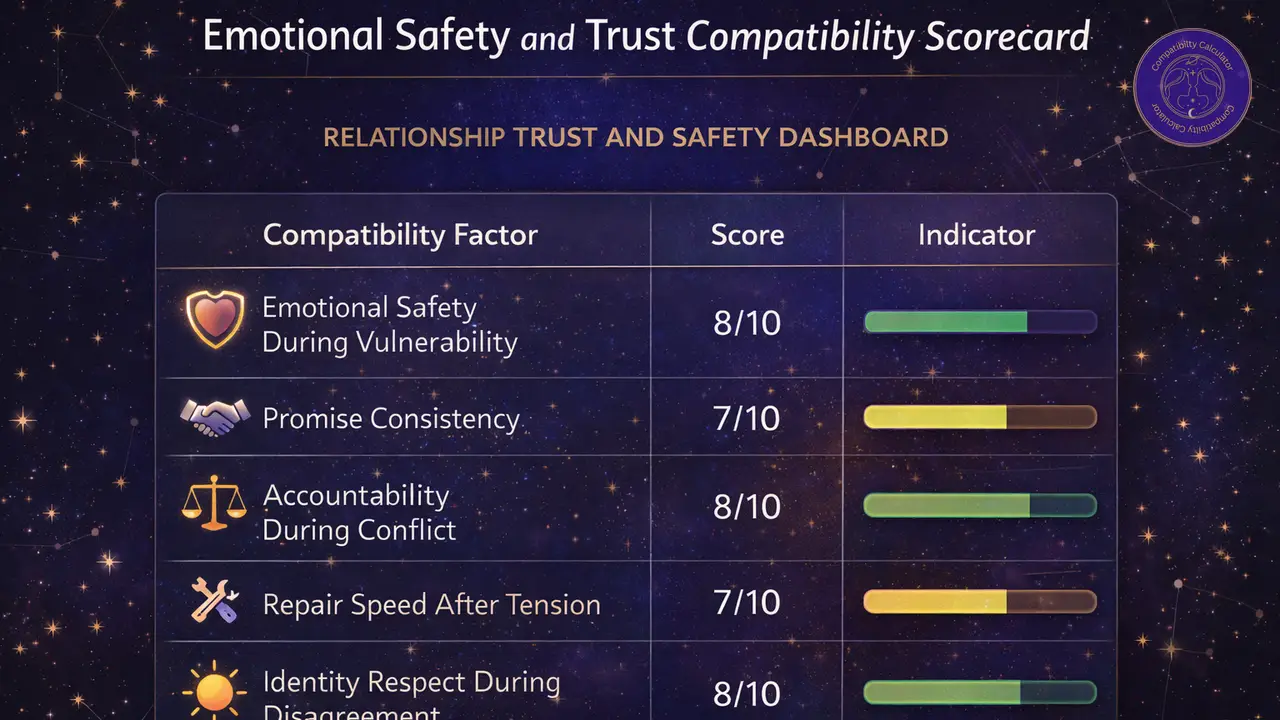
Relationship trust and safety dashboard showing reassurance, repair, consistency, and emotional security patterns.
Safety and trust become easier to read when reassurance, repair, and consistency stay visible over time.

Emotional safety can improve when both people change their repeated responses, not only when they feel affection. A deeper look at whether emotional compatibility can improve over time helps explain that process, and emotional vs physical compatibility separates comfort from attraction more clearly.

Compatibility Scorecard

Use this reflection scale honestly. Rate each area from 1 to 10 based on repeated behavior rather than occasional good days.

  • Emotional safety during vulnerability
  • Consistency in keeping promises
  • Accountability during conflict
  • Speed of repair after tension

A high score does not mean there are no arguments. It means recovery feels predictable.

This kind of trust pattern also appears outside romance, especially in close friendships where people expect support without always naming it. The guide on astrology compatibility in friendships gives that wider context, while the compatibility calculator tool can give a quick reading before you study the emotional details.

If a score is part of the reading, it should be treated as a starting point for reflection. The page on astrology compatibility calculator accuracy explains why emotional results need context from real behavior.

Reflection Section

Consider these questions based on real experience rather than hope.

  • Do we feel safe sharing insecurity without regret later
  • Do repeated conflicts reduce in intensity over time
  • Do apologies lead to visible change
  • Do both of us feel respected even when we disagree

Your answers will reveal more about compatibility than attraction alone.

Frequently Asked Questions

Is emotional safety purely determined by astrology?

Astrology shows tendencies in emotional reaction, especially through the Moon and Saturn. Real safety still depends on conscious behavior and maturity.

Can trust exist without strong emotional safety?

Trust may exist in routine matters such as finances or responsibility. Without emotional safety, however, openness stays limited.

Does one betrayal permanently destroy compatibility?

Some couples rebuild trust through consistent accountability. Others struggle because defensiveness remains stronger than responsibility. The outcome depends on repeated behavior after the breach.

How can someone know if trust is realistically rebuildable?

Trust can be rebuilt when responsibility is steady, transparency increases, and defensive reactions decrease over time.

About the Author

Photo of author
Anikesh Panda writes about zodiac compatibility with a focus on how people actually behave in relationships. His work comes from observing patterns in communication, emotional reactions, and how couples handle conflict over time. Through CompatibilityCalculator.net, he translates these patterns into practical compatibility insights meant for general understanding.
Compatibilty Calculator favicon

CompatibilityCalculator.net helps you understand how zodiac signs interact in real relationships. The insights come from years of studying astrology patterns and observing how different personalities connect.

Contact

contact@compatibilitycalculator.net

Address

Bhubaneswar, Pin: 751009

State and Country

Odisha, India