Mercury compatibility shows up in ordinary exchanges: how a message is written, how quickly someone answers, whether a joke feels warm or sharp and whether a disagreement becomes clearer or more confusing. The point is not to label one person articulate and the other difficult. It is to see where timing, tone and interpretation diverge.

How Different Minds Move
One person may explain every detail because context feels necessary. The other may want the main point first and ask for detail later. A fast reply can feel engaged to one person and careless to another, while a slow reply can feel thoughtful to one and avoidant to the other.
A Simple Scene
A partner sends a short message about changing the evening plan. The reader sees the short wording as annoyance and begins defending the decision. The sender meant to be efficient and is surprised by the response. The repair starts when both people separate the words on the screen from the meaning they assigned to them.
When Conversation Feels Easy
Conversation feels easier when both people can ask for the missing context without turning the request into an accusation. One may speak directly while the other uses a softer opening, yet both can still make room for the other’s pace.
How Arguments Actually Sound

Mercury tension often begins with a small mismatch: one person wants an answer now, the other needs time to organise the thought. The first may repeat the question; the second may become shorter or more defensive. Repair needs a clear pause, a return time and one question at a time.
Clarifying Instead of Assuming
A useful clarification asks, ‘Did you mean that you disagree with the plan, or that you need more time?’ That question keeps the conversation open. It also prevents a person from arguing against an intention that was never stated.
Humour, Directness and Sensitivity
Humour can reduce pressure for one person and hide the seriousness of an issue for another. Direct wording can feel honest to one person and critical to the other. A couple does not need identical communication styles, but both people need to learn which signals make the other person shut down.
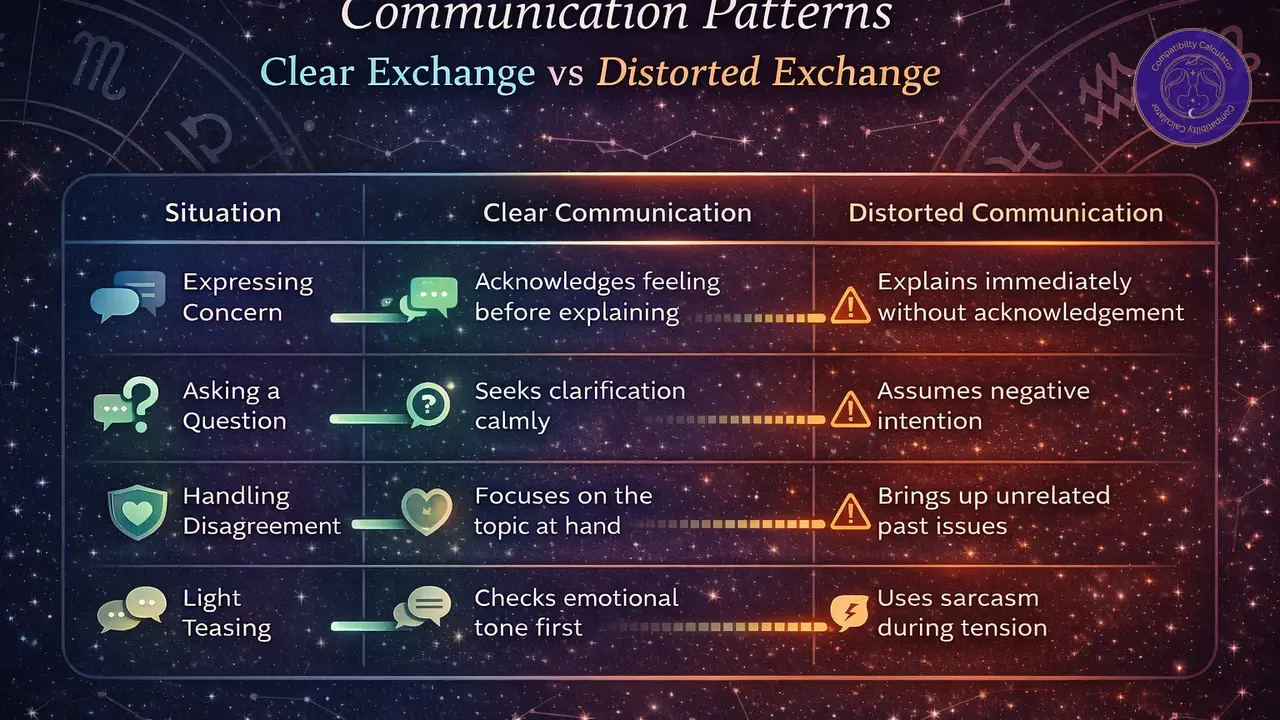
Clear Exchange vs Distorted Exchange
| Communication point | Clear exchange | Distorted exchange |
|---|---|---|
| Timing | A pause is named and a return time is given. | Silence is left for the other person to interpret. |
| Tone | The concern is stated without a character judgment. | The person is attacked instead of the problem being named. |
| Listening | The answer responds to the question asked. | The reply answers a different fear or assumption. |
| Repair | Both people can restate what they heard. | The same sentence is repeated with more force. |
When Words Become Sharp Instead of Helpful
The trigger may be a forgotten task. One person says, ‘You never listen,’ and the other responds, ‘You make everything a problem.’ The first person becomes more urgent; the second withdraws. The conflict is no longer about the task. A better repair names the missed action, the impact and the next step without using a permanent label.
When Words Restore Trust
Repair can be short and specific: ‘I read your message as dismissive, but I know that may not be what you meant. Can you tell me the main point again?’ The other person can answer the question before defending their character. This sequence gives the conversation somewhere to go.
A Mercury Reflection Checklist
- Notice who wants the main point and who wants the context first.
- Name the meaning you heard before arguing with the intention.
- Give a pause a clear return time.
- Replace character labels with the action, impact and repair needed.
This page owns communication behaviour. The planetary parent guide explains how Mercury fits beside the Sun, Moon, Venus, Mars, Jupiter and Saturn. Use Full Chart compatibility when the question depends on wider chart contacts.
FAQs
Can different communication styles improve?
They can become easier when both people name the difference, respect timing and practise clear repair instead of guessing at intent.
Is intellectual chemistry enough for stability?
No. Good conversation does not remove disagreements about emotional safety, affection, boundaries or responsibility.
Why do couples argue about small issues repeatedly?
The small issue may be carrying a larger concern about being heard, respected or remembered. The pattern changes when the underlying concern is named.
How can I tell if miscommunication is serious?
Look for repeated contempt, refusal to clarify, punishment through silence or a pattern in which repair never occurs. A single awkward exchange is not the same thing.